Groom Attire
Coordinating the Groom's Look Without Seeing the Dress
Keeping the gown a surprise? You can still align his suit perfectly — by anchoring to formality, the wider palette, and metal tone, none of which give the dress away.
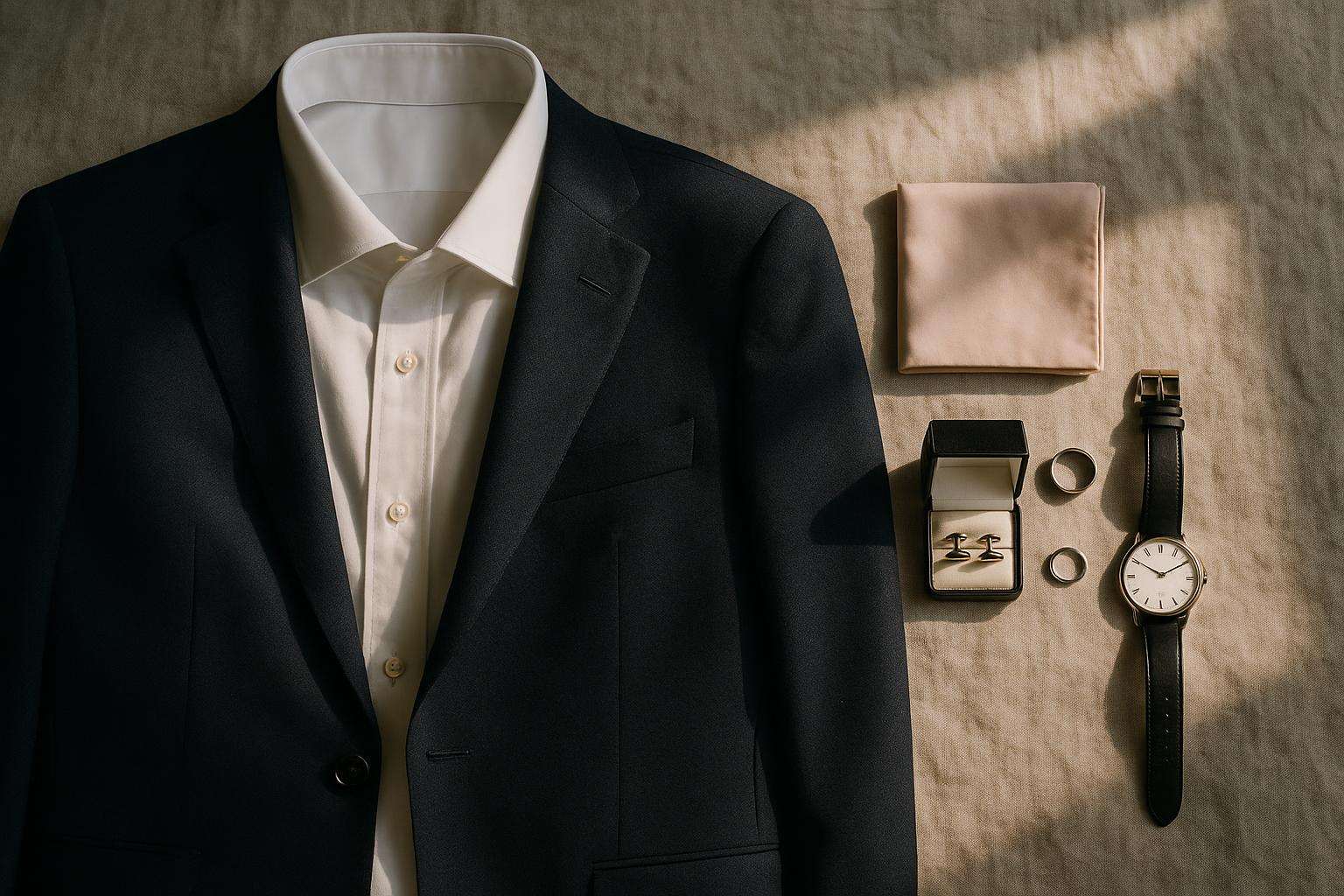
A groom does not need to see the gown to look like your deliberate match. Coordinate blind by anchoring to three things the dress never reveals: the dress code (which sets how formal he should be), the wider color palette (which his suit complements rather than copies), and the metal tone of the rings and your jewelry (which his cufflinks and watch echo). Share those freely; keep silhouette, neckline, and fabric a secret. The surprise survives, and the photographs still read as one.
Keeping the gown hidden until the aisle is one of the loveliest traditions a couple can choose — and one of the most fretted-over, because it raises an obvious question: how can he coordinate his look to something he has never seen? The reassuring truth is that the dress was never the thing his attire keyed off in the first place. Couples almost never wear matching colors; the aim is cohesion, not a literal match. And cohesion is built entirely from variables that live outside the gown. With a little planning, a groom can dress for a dress he will only meet when you walk toward him.
Can a groom coordinate his look without seeing the dress?
Yes, comfortably. Begin from the truth that nearly every wedding gown is ivory, white, or champagne — a near-neutral against which a darker suit simply reads as contrast. The dress color almost never constrains his suit color. What he is really coordinating with is the aesthetic of the wedding: its formality, its palette, its season and setting. As Hockerty advises, a groom should anchor to the overall scheme rather than to the gown. None of those anchors require him to have seen a single seam of your dress.
Think of it the way a tailor does. The dress is one note; his suit is another; the day's formality and palette are the key the whole composition is written in. Get the key right and the two of you are in harmony — whatever the dress turns out to be.
What can the bride safely share without revealing the dress?
Plenty — and sharing it generously is what makes blind coordination work. You can disclose every coordinating variable that isn't the gown itself, and none of them spoil the surprise:
- The dress code printed on the invitation — white tie, black tie, black-tie optional, formal, cocktail, semi-formal, or garden/casual.
- The color palette — bridesmaid dress colors, floral and linen tones, the overall mood, whether warm or cool.
- The metal tone of your jewelry and the rings — gold, or silver/white-gold/platinum.
- Optionally, a one-word temperature cue — whether the gown is warm ivory/champagne or cool bright-white.
What stays secret is everything that actually makes the gown a surprise: silhouette, neckline, sleeves, train, fabric, beading, length. Reassuringly, not one of those affects a single decision he has to make. He can be fully coordinated and still genuinely gasp when you appear.
How does the dress code set the groom's look?
The dress code is the spine of his outfit, and it is knowable the moment the invitation is printed. It tells him exactly how dressed-up to be — independent of the gown. The tiers, from most formal down, look like this:
| Dress code | What the groom wears | Safe suit colors |
|---|---|---|
| White tie | Black tailcoat, white piqué waistcoat, white bow tie, formal black shoes | Black only |
| Black tie | A tuxedo — satin lapels, black bow tie, polished/patent shoes (a suit will not do) | Black, midnight navy |
| Black-tie optional / formal | A tuxedo or a dark, well-tailored suit; lean tux if the groomsmen are in tuxedos | Charcoal, navy, black |
| Cocktail / semi-formal | A suit and tie; darker for evening, lighter for daytime | Navy, grey, burgundy, green |
| Garden / casual | A lighter suit or odd jacket with dress trousers; linen or lighter wools | Light grey, beige, dusty blue, sage |
The distinction between a tuxedo and a suit is real: a tuxedo carries satin-faced lapels and a satin trouser braid, where a suit holds one cloth throughout. The Knot's dress-code guide and Inside Weddings' levels-of-formality guide both stress that true black tie means a tuxedo, full stop. Suits begin around $300 at retail and tuxedos around $600, though rental services such as The Black Tux and Generation Tux have made either tier accessible without a purchase.
How do you match color and season without the dress?
Anchor to the palette, not the gown — and start from the safe center. Navy, charcoal, grey, and black are near-universal grooms' colors precisely because they sit comfortably at almost any formality and contrast cleanly against ivory or white. From that center, tune to the palette and the season. Against soft palettes — blush, champagne, sage — a light grey or a classic navy reads clean and uncluttered. Against deep palettes — burgundy, forest, wisteria — navy or charcoal gives complementary depth. For warm-weather and outdoor venues, lighten the cloth itself to linen or a lighter wool; reserve flannel, tweed, and heavier worsteds for autumn and winter. The cleanest single tie-in, requiring no knowledge of the dress at all, is a pocket square or tie pulled from the palette — the bridesmaid color is a reliable, photogenic choice.
How do you match metal tones blind?
This is the detail that photographs at close range — the wrist, the cuff, the ring resting on her hand — and it is fully knowable in advance. The rule is simple: his cufflinks and watch should echo the wedding band's metal. A yellow-gold band pairs with warm, gold-toned cufflinks; a white-gold, platinum, or silver band pairs with rhodium or silver. Then he coordinates with your jewelry's tone, which you can share now: warm and ivory themes lean gold, while cool blue or grey themes lean silver. Mixing metals is perfectly acceptable in practice — silver and gold sit together well — and a two-tone steel-and-gold watch is a useful "centerpiece" that bridges both if either of you is unsure. For black tie, restraint wins: polished silver, mother-of-pearl, or onyx rather than color; a more relaxed celebration opens the door to enamel and colored stones. One practical note on timing — order anything engraved or personalized about four to six weeks ahead, so the wrist looks intentional rather than improvised on the day.
Frequently asked
Does the groom actually need to see the dress to coordinate his suit?
No — and most couples who keep the gown a surprise coordinate beautifully without it. The two of you almost never wear matching colors anyway; the goal is cohesion, not a literal match. Everything that ties your looks together lives outside the dress: the stated dress code, the wider wedding palette, the season and venue, and the metal tone of the rings. Because nearly every gown is ivory, white, or champagne, it reads as a neutral that his darker suit simply contrasts with. As Hockerty notes, anchoring to the overall aesthetic — not the dress itself — is the more reliable approach.
What can I tell him about the dress without giving away the surprise?
Share every coordinating variable that isn't the gown itself. Safe to disclose: the formality or dress code on the invitation, the wedding's color palette (bridesmaid colors, florals, linens), the metal tone of your jewelry and the rings, and — if you like — a one-word temperature cue, such as whether the gown is warm ivory or cool bright-white. What stays secret is everything that actually makes the dress a surprise: the silhouette, neckline, sleeves, train, fabric, and beading. None of those affect his suit decisions, so the reveal survives completely intact while he still has everything he needs to look like your deliberate match.
Can he wear a navy or charcoal suit if he doesn't know the dress?
Yes — navy, charcoal, grey, and black are the near-universal grooms' colors precisely because they sit comfortably at almost any formality and contrast cleanly against an ivory or white gown. Navy is the most flexible and the most photogenic of the four. Tune the choice to the palette and season rather than the dress: soft palettes such as blush or sage read beautifully against navy or light grey, while deep palettes like burgundy or forest gain complementary depth from charcoal. For warm-weather and outdoor venues, lighten the cloth to linen or a lighter wool. He genuinely cannot go far wrong with a well-tailored navy suit.
How do we match metal tones if he can't see my jewelry on the day?
You don't need the day — you need one fact you can share now: the metal of the rings. The rule from Menswear Style is that his cufflinks and watch should echo the wedding band — a yellow-gold band pairs with warm/gold-toned cufflinks, while a white-gold, platinum, or silver band pairs with rhodium or silver cufflinks. Then tell him your jewelry's tone so it harmonizes: warm and ivory themes lean gold; cool blue or grey themes lean silver. Mixing is fine in practice, and a two-tone steel-and-gold watch bridges both if you're unsure.
What if the wedding is black tie — does the surprise change anything?
Not at all, because black tie is dictated by the dress code, not the gown. Black tie means a tuxedo: satin-faced lapels, a black bow tie, and polished or patent shoes — a regular suit, however fine, does not satisfy it, per The Black Tux. Midnight navy is an accepted modern alternative to black. If the groomsmen are in tuxedos, the groom should lean tux to lead the party. For accessories, black tie rewards restraint: polished silver, mother-of-pearl, or onyx rather than color. The formality answers itself the moment you read the invitation.
How far in advance should he sort accessories and order anything engraved?
Lock the suit and shoes first, since those define the formality, then layer accessories last so they can follow the palette and metal tone. Off-the-rack accessories such as ties, pocket squares, and standard cufflinks can be sourced fairly late. Anything personalized or engraved, however, needs lead time: order engraved cufflinks roughly four to six weeks before the wedding to allow for production, shipping, and any corrections. Rentals from services like The Black Tux or Generation Tux should also be reserved well ahead so the fitting timeline has room. Build in a buffer — a calm groom photographs better than a rushed one.