Groom Attire
Morning Dress for the Groom: The Formal Daytime Tradition Explained
The morning coat, the contrasting waistcoat, the grey striped trousers — what morning dress is, when he should wear it, and how to get it right for a traditional daytime wedding.
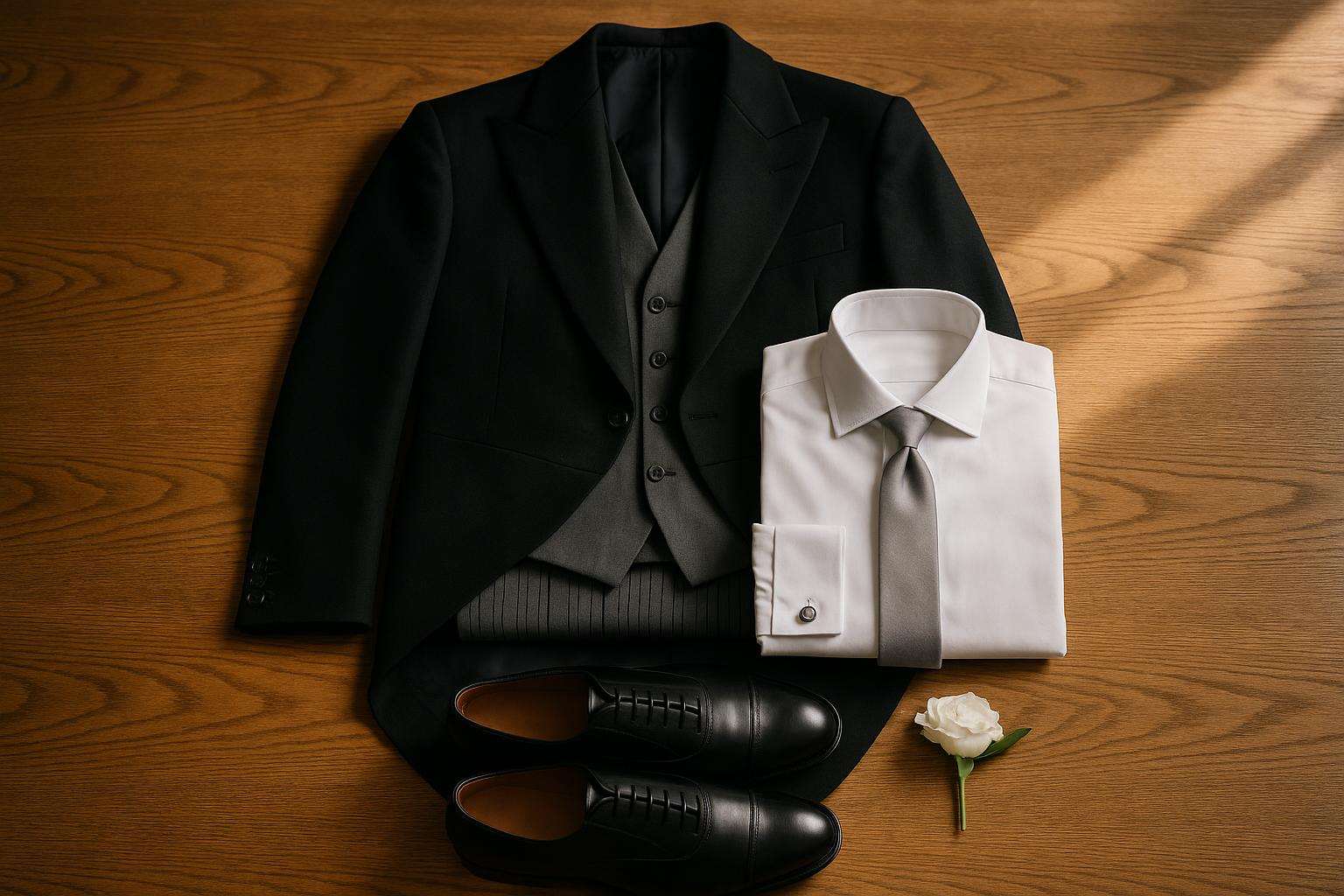
Morning dress is the most formal thing a man can wear before six o'clock: a cutaway morning coat, a contrasting waistcoat (traditionally dove grey or buff), and grey striped trousers, finished with a white double-cuff shirt and black Oxfords. It is the British standard for grand daytime weddings; a tuxedo, by contrast, is evening wear. If his ceremony is formal and begins before 6 p.m., morning dress is the historically correct — and quietly magnificent — choice.
There is a particular kind of wedding that asks for it: a daytime ceremony in a beautiful church or on the lawn of a country estate, a guest list dressed with care, and a couple who want the photographs to look as timeless in fifty years as they do on the day. For that wedding, the most formal thing the groom can wear is not a tuxedo at all — it is morning dress. If you have been picturing him in the cutaway coat and striped trousers you have seen at royal weddings and Royal Ascot, this is the tradition you are reaching for, and it is worth understanding before he books a fitting.
What is morning dress, and what are its parts?
Morning dress is the daytime equivalent of white tie — the highest level of formal daytime attire, with roots in nineteenth-century British tailoring. The ensemble has three defining pieces. The first is the morning coat, a single-breasted coat with peaked lapels, fastened with a single button, cut away at the front waist and sweeping into knee-length tails at the back; it is traditionally black or Oxford-grey herringbone wool. The second is the waistcoat, always worn, traditionally a lighter shade than the coat — dove grey, buff, or pale blue — whose gentle contrast with the coat is a signature of the look. The third is the pair of formal trousers, grey-and-black striped or houndstooth, worn without turn-ups and held up with braces rather than a belt, as Debrett's-aligned guidance describes.
To complete it, he wears a white shirt with a turn-down collar and double (French) cuffs fastened with cufflinks, a muted silk tie or a cravat, and plain black non-patent leather Oxford shoes. The traditional accessories — a grey top hat, gloves, and a boutonnière — are expected at the grandest occasions and optional at a wedding. There is also a quiet distinction in British usage between morning dress, where the pieces contrast, and a morning suit, where the coat, waistcoat, and trousers are cut from one matching grey cloth — the latter a softer, summery version popular for the races, per Aristocracy London.
When should the groom wear morning dress instead of a tuxedo?
The rule that governs everything here is the time of day. Morning dress is daytime wear, correct for events that begin before 6 p.m.; anything starting at or after six belongs to evening dress, where white tie is the formal standard and a tuxedo is the black-tie option. A tuxedo worn at a daytime ceremony is, strictly speaking, out of place — the historically correct daytime formal garment is the morning suit, not the dinner jacket, as Phillip Alexander sets out. So the question is rarely "morning suit or tuxedo?" in the abstract; it is "what time does the ceremony start, and how formal is it?"
| Morning suit | Tuxedo | |
|---|---|---|
| Time of day | Daytime — before 6 p.m. | Evening — after 6 p.m. |
| Dress code | Morning dress / formal daytime | Black tie |
| The jacket | Cutaway coat with tails, peaked lapels | Dinner jacket with satin lapels |
| Trousers | Grey striped or houndstooth, no turn-ups | Dark with a satin side stripe |
| Neckwear | Silk tie or cravat | Bow tie |
| Shoes | Black non-patent Oxfords | Black patent leather |
| Most at home | Grand daytime weddings, Royal Ascot | Evening receptions, ballrooms |
Is morning dress expected at American weddings?
This is mostly a British convention. In the United Kingdom, the morning suit is the expected groom's attire at a formal daytime wedding, and it is famously the dress code of the Royal Enclosure at Royal Ascot. In the United States the picture is different: morning suits are rarely seen, and many grooms wear a tuxedo even during the day — technically incorrect by the old rules, but widely accepted in practice, as Gentleman's Gazette observes. For an American groom, then, choosing morning dress is a deliberate signal: it says the wedding is traditional, formal, and built around the daytime hour. There is nothing wrong with that — it is one of the most elegant things he can wear — but it works best when the rest of the wedding matches it and when guests are told what to expect, so he is not the only man in tails.
If the wedding is formal but you would rather not go all the way to a cutaway, a fine daytime lounge suit or a stroller (a dark jacket with striped trousers) sits one notch down and is perfectly correct for the morning or early afternoon.
Should the groom buy or rent a morning suit, and what does it cost?
A true cutaway morning suit is a specialty item. Mainstream US rental houses such as Men's Wearhouse and Generation Tux build their catalogs around tuxedos and lounge suits — tailcoats are noted as their most formal tier — but a classic morning coat is not always a standard rental, so you may need a dedicated formalwear shop to find one. In the UK, specialty houses such as Favourbrook offer off-the-peg and made-to-measure morning wear with a proper consultation.
For a sense of cost, US ceremony-attire rentals average around $205 according to The Knot's 2025 Real Weddings Study, with most rentals landing between $150 and $300; Generation Tux rentals start near $149, with the option to buy a suit outright. The decision comes down to the future: if morning dress will be a one-day look, renting is sensible; if he expects more formal daytime occasions ahead, buying or going made-to-measure can be the better value and will always fit him best. Whichever way you go, book the fitting early — a cutaway coat rewards a careful tailor, and a morning suit that fits beautifully is what turns a costume into the way a man looks on the best day of his life.
Frequently asked
Is a morning suit the same thing as morning dress?
In everyday wedding planning the two terms are used interchangeably, but there is a small purist distinction. Morning dress properly means a contrasting outfit: a black or Oxford-grey cutaway coat, a lighter waistcoat, and grey striped trousers. A morning suit, in strict British usage, is the slightly less formal version where the coat, waistcoat, and trousers are all cut from a single light- or mid-grey cloth — a favourite for summer weddings and the races, per Gentleman's Gazette. For your wedding, either reads as fully formal daytime attire; the contrasting version is the grander of the two.
Can he wear a morning suit at an American wedding?
He certainly can, and at a grand, traditional, or church wedding it looks wonderful — but understand that it will read as a deliberate choice. Morning dress is the British standard for formal daytime weddings; in the United States it is rarely seen, and grooms more commonly reach for a tuxedo or a fine daytime suit, as Phillip Alexander notes. If the wedding is formal and before six o'clock, a morning suit is the historically correct and quietly distinguished option. Just prepare guests with a clear dress code so he is not the only man in tails.
What colour waistcoat should the groom wear with morning dress?
The most traditional choice is a waistcoat lighter than the coat — dove grey or buff — which creates the gentle contrast that defines classic morning dress. Pale blue and soft pastels have become popular for weddings and are perfectly acceptable, while a muted pattern can add a personal note without tipping into costume. Whatever the shade, fit matters most: the waistcoat should sit smoothly with no gap above the trousers, and a sliver should show beneath the buttoned coat. A waistcoat is never optional with a morning coat — it completes the look.
Does he wear a top hat with morning dress?
A grey top hat is the traditional finishing piece, along with gloves and a boutonnière, and at a very formal occasion such as Royal Ascot it is expected. At a modern wedding it is entirely optional. Many grooms carry the hat rather than wear it, or skip it altogether and let the coat and waistcoat do the work. If he loves the romance of the full ensemble, a top hat is correct and looks splendid in photographs; if he would feel self-conscious, leaving it off does not undermine the formality of the outfit.
Should the groom buy or rent a morning suit?
It depends on how often he will wear it again. A true cutaway morning suit is a specialty garment, so it is not always a standard rental at mainstream houses; you may need a specialist formalwear shop. For a price anchor, US ceremony-attire rentals average around $205 according to The Knot, with most rentals falling between $150 and $300. If morning dress will be a one-time look, renting is sensible; if he expects future formal daytime events — Ascot, other traditional weddings — buying or made-to-measure can be the better value over time. Book the fitting early either way.