Groom Attire
The Navy Wedding Suit: Why It's the Groom's Safest Bet
Across formality, season, venue and complexion, navy is the one suit color that flatters nearly every groom — and keeps earning its place in his closet long after the day.
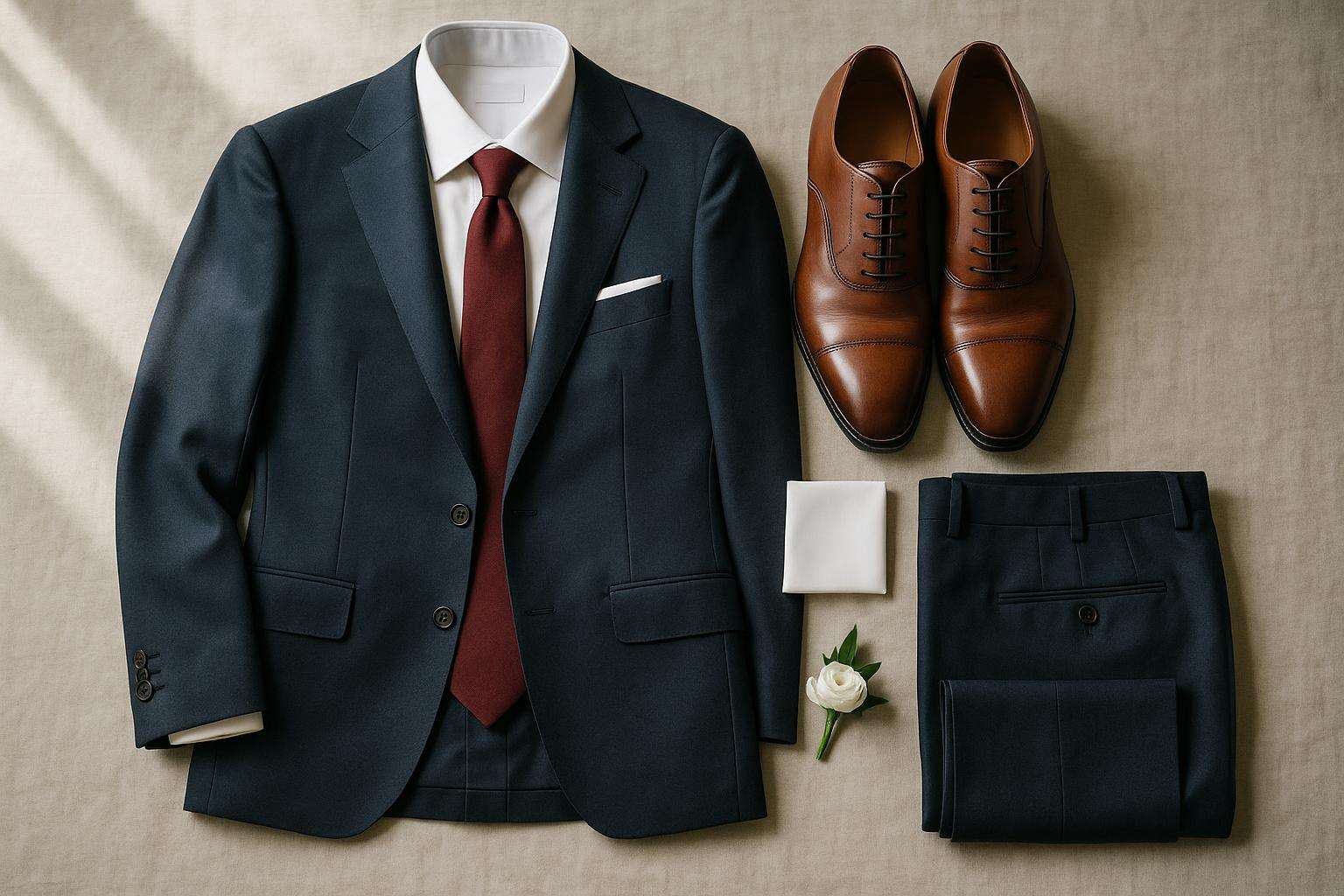
Navy is the groom's safest bet because no other color is this versatile: it flatters nearly every complexion, photographs with depth indoors and out, and scales from a garden ceremony at noon to a formal evening reception with only a change of tie and shoes. Best of all, a navy suit keeps earning its place in his closet long after the wedding — which is why, of all the colors you might steer him toward, this is the one you can recommend without a second thought.
When you are helping plan a wedding and the question of what he should wear comes up, the wisest first move is not to chase a trend — it is to choose a color that cannot go wrong. For the overwhelming majority of grooms and weddings, that color is navy. It has been a fixture of classic menswear for generations precisely because it walks the line between formal and approachable, and it does so more gracefully than any other shade he might consider.
Why is navy the most versatile groom suit color?
The case for navy begins with range. A single navy suit can travel the full formality spectrum — from a relaxed daytime gathering to an elegant evening event — provided the shirt, shoes and accessories are matched to the moment. The menswear authority Gentleman's Gazette builds an entire guide around wearing one navy suit seven different ways, and even breaking it apart — pairing just the jacket with grey trousers in the Italian spezzato tradition for a more relaxed look. That is the heart of the argument: navy is not a single-occasion costume but one highly versatile garment that adapts to whatever the day requires.
Set navy against its rivals and the advantage sharpens. Black can read as severe, even funereal, and truly belongs to black-tie. Pale blue and royal blue are lovely but lock the look to summer and daytime. Navy holds the broad, useful middle — dressy enough for an evening reception, easy enough for a vineyard at midday.
Does navy flatter every skin tone — and photograph well?
Two things matter enormously on a wedding day: how a color sits against the groom's face, and how it behaves in the camera. Navy excels at both. It is widely described as universally flattering, coordinating with a wide range of skin tones and nearly any wedding palette — from soft pastels to bold jewel tones — and it photographs beautifully in both indoor and outdoor settings, a point The Knot makes plainly.
This is more practical than it sounds. A true black often flattens into a shapeless silhouette under flash, losing all its tailoring detail, while a very pale blue can wash a fair groom out in bright sun. Navy keeps its visible texture and depth in photographs, which is exactly why wedding stylists reach for it again and again. If you want him to look like himself — and to look that way in the pictures you will keep forever — navy is the dependable choice.
How do I match a navy suit to the season, venue and palette?
Navy's versatility is unlocked through shade, fabric weight and accessories. Save deep, heavier navy for cooler months, and reach for a lighter or dustier navy — or a breathable, high-twist wool — for warm weather, the same logic that keeps flannel out of summer and seersucker out of winter. For a formal evening wedding, a dark navy reads classic and refined; for a summer or beach celebration, a lighter, airier blue works beautifully.
For accessories, navy is remarkably accommodating. It harmonizes with brown, burgundy, silver, gold, blush and sage — so you can pull the wedding palette straight into his tie, pocket square or boutonniere. The default footwear is cognac or medium-to-dark brown leather, worn with a matching belt; black shoes simply dress the suit up toward black-tie. A burgundy or silver tie keeps things traditional and timeless.
| Setting | Navy shade & fabric | Shirt & tie | Shoes |
|---|---|---|---|
| Daytime / outdoor / summer | Lighter navy, breathable high-twist wool | White or pale blue shirt; burgundy or patterned tie | Cognac brown |
| Semi-formal reception | Mid-to-deep navy, year-round wool | White shirt; silk tie in a palette color | Dark brown or oxblood |
| Formal evening | Deep / midnight navy, smooth wool | Crisp white shirt; refined silk tie | Polished black |
How does the groom stand apart if his men also wear navy?
It is common — and very elegant — for the whole party to wear navy. The way to keep the groom distinct is not a different suit but a different detail. A tie or pocket square in a contrasting color or texture, a different vest, a finer fabric, or a boutonniere only he wears will set him apart without overshadowing his groomsmen. The result is a party that reads as unified in the photographs, with the groom unmistakably at its center. Restraint, here, is the elevated move.
What real navy suits should a groom consider, and what do they cost?
The good news is that an excellent navy suit exists at nearly every budget. At the contemporary made-to-measure end, Indochino builds navy suits — such as the Milano in Italian Guabello wool or the Super 100s Hemsworth — to the groom's exact measurements, half-canvassed, starting around $399 and reaching about $699 for premium cloth, delivered in roughly two to three weeks. SuitSupply's Lazio is its most modern, tapered cut in pure S110's wool from the storied Vitale Barberis Canonico mill, half-canvassed, and uniquely offered with mix-and-match sizing so a groom can pair a larger jacket with slimmer trousers; the navy Napoli is a slightly more classic slim fit that flatters most body types. Both generally land in the $499–$699 range.
For a contemporary European silhouette, Hugo Boss offers navy in wool and stretch blends broadly in the $400–$900-plus range, while Brooks Brothers anchors the traditional, timeless end with its Wool 1818 and slim navy suits in fine Italian and English cloth, roughly $600 and up. Whichever he chooses, prioritize a clean shoulder and a half-canvassed (not fully fused) construction, then have it tailored to fit — because with navy, the color is already doing the hard work for you.
That is the quiet luxury of recommending navy: it is the rare wedding decision with almost no downside. He will look composed and handsome on the day, the photographs will hold up, and the suit will hang in his closet for years as the one he reaches for whenever the occasion calls for it.
Frequently asked
Is a navy suit appropriate for a formal wedding?
Yes — navy is one of the few colors that scales comfortably from a relaxed daytime celebration to a formal evening reception. The trick is in the details, not the suit. For a formal evening wedding, a deep, dark navy in a smooth wool reads classic and elegant, and you can push it toward black-tie-adjacent territory with a white shirt, a refined silk tie, and polished black shoes. For anything short of true black-tie, navy is entirely at home. Only a literal black-tie dress code (which calls for a tuxedo) sits outside navy's range — and even then, a midnight-navy dinner jacket is a celebrated alternative to black.
What shoe color goes with a navy wedding suit?
Brown is the classic and most versatile pairing. Cognac or medium-to-dark brown leather — in an oxford or derby — complements navy beautifully and keeps the look warm and wedding-appropriate, especially for daytime and outdoor settings. As The Knot notes, darker browns suit deeper navy while lighter tans pair better with lighter blues. Black shoes are not wrong — they simply dress the suit up, nudging it toward formal evening or black-tie-adjacent looks. For most weddings, a polished cognac brown is the safe, photogenic choice, worn with a matching brown leather belt.
Navy or charcoal — which is the better groom suit?
Both are excellent, safe neutrals, so it comes down to warmth and complexion. Navy is generally the more flattering and friendly of the two: it brings a touch of color, photographs with visible depth, and suits a very wide range of skin tones. Charcoal reads slightly more formal, somber and corporate, and can be more forgiving on very fair grooms in harsh light. For a wedding — a warm, celebratory occasion that lives in photographs — navy usually wins for the groom, with charcoal a strong fallback if he already owns a navy suit or wants maximum formality.
Can the groom and groomsmen all wear navy?
Absolutely, and it is a popular, cohesive look. To keep the groom distinct without buying him a different suit, give him a different accessory — a tie or pocket square in a contrasting color or texture, or a different vest. Generation Tux recommends exactly this: an elevated touch that sets the groom apart without overshadowing the party. You can also shift the groom to a subtly different shade or a finer fabric, or add a boutonniere only he wears. The goal is for him to read as the center of the group in the photos, while the party stays unified.
Is navy too warm for a summer wedding?
Not if you choose the right weight and shade. Color and fabric do the seasonal work: save deep, heavy navy for cooler months, and for summer reach for a lighter navy or a lightweight, breathable wool such as a high-twist or fresco weave, which lets air through. A lighter or dustier blue is also a perfectly groom-appropriate warm-weather alternative. As long as you match the cloth weight to the season — no flannel in July — navy works beautifully for outdoor and summer celebrations, and it still photographs with the depth that very pale suits can lose in bright sun.
Should he buy or rent a navy wedding suit?
This is where navy's versatility pays off. Because a navy suit is genuinely wearable long after the wedding — to work, other weddings, and evenings out — buying is usually the better value for the groom himself, even if groomsmen rent. A made-to-measure navy from Indochino starts around $399 and is built to his measurements, while a SuitSupply Lazio or Napoli lands in the $499–$699 range off the rack. If the budget is tight or the suit truly will never be worn again, renting is reasonable — but navy is the one color where ownership almost always earns its keep.