Groom Attire
Suit or Tuxedo? How to Choose by Your Wedding's Exact Formality Level
The choice is already made for you — by the dress-code line on the invitation and the hour the ceremony begins. Here is how to read both and dress him correctly.
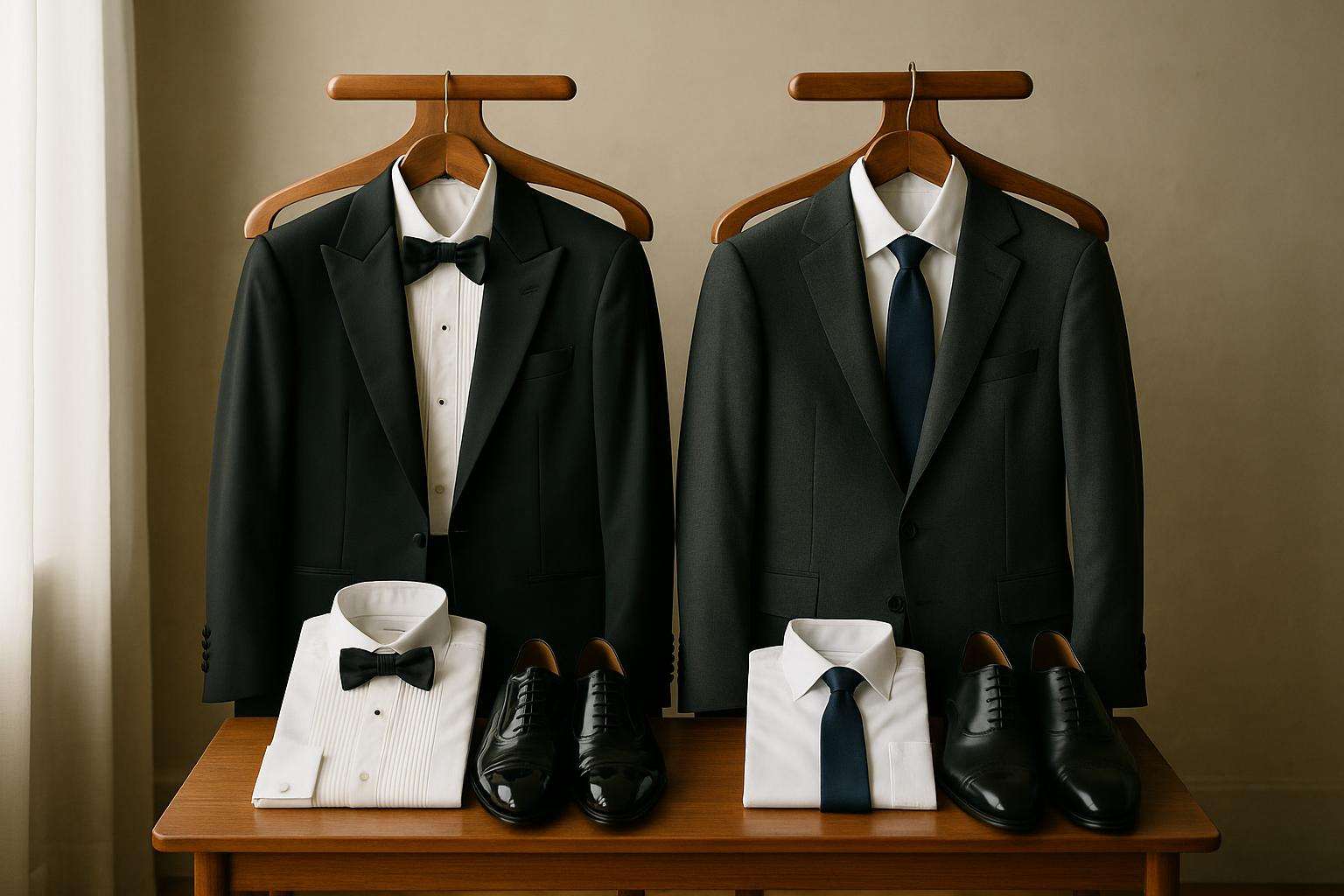
The groom keeps framing it as a matter of taste — suit or tuxedo, as if it were his to invent from scratch. It is not. The choice has, in fact, already been made for him by two pieces of information you both already hold: the dress-code line on the invitation and the hour the ceremony begins. Read those two cues correctly and the decision resolves itself, calmly, every time. This guide gives you the framework to do exactly that, then layers in the lapel and fabric details that separate a tuxedo from a suit and one tuxedo from another.
The short version: Black tie means a tuxedo, full stop. Black-tie optional means a tux is preferred but a perfectly fitted dark suit is honorable. Formal leans suit, tux welcome. Semi-formal / cocktail means a dark suit and the tux is now too much. Casual or daytime means a lighter suit. And a tuxedo is evening wear — traditionally not worn before 6 p.m.
What actually makes a tuxedo a tuxedo (and not just a black suit)?
Before mapping the dress codes, settle the definition, because the most common mistake is assuming a black suit will pass for a tux. It will not. The defining difference is the lapel facing and the trim — not the color. A tuxedo's lapels are faced in silk, either glossy satin or ribbed, matte grosgrain; its buttons are covered in that same silk; and its trousers carry a matching silk braid down the outer seam. A suit's lapels are cut from the same cloth as the jacket, its buttons are horn or plastic, and its trousers are plain. As The Black Tux puts it, the lapel facing is the single biggest tell. So a black suit, however sharp on him, is categorically not a tuxedo — a distinction that matters most at the one dress code that demands the real thing.
How do you map each wedding dress code to a suit or a tux?
Here is the translation, from most formal to least. Find the line printed on the invitation and read across.
| Dress code | Tuxedo | Suit | The correct read |
|---|---|---|---|
| Black tie | Required | Not appropriate | Tuxedo, black bow tie, white dress shirt, polished black shoes. No interpretation. |
| Black-tie optional | Preferred | Acceptable | Tux is the safe choice; a perfectly fitted dark suit with a black tie is the honorable alternative. |
| Formal | Optional | Preferred | A dark, well-cut two- or three-piece suit; a tux is welcome but not required. |
| Semi-formal / cocktail | Too formal | Required | Navy or charcoal suit, pocket square, polished shoes; tie or open collar by the hour. |
| Casual / daytime / outdoor | Overdressed | Best choice | Lighter fabric — linen, cotton-blend, tropical wool — in tan, light grey, or soft blue. |
Note the quiet trap in the word formal: despite how it sounds, it sits a notch below black tie, as Generation Tux explains. At a formal wedding a tuxedo is permitted but not expected, and a beautifully cut dark suit is entirely at home. The dress code that genuinely brooks no substitution is black tie alone.
Why does the time of day change the answer?
The dress-code line is only half of it. Tradition holds the tuxedo is evening wear, and the long-standing convention is that wearing one before roughly 6 p.m. is a misstep. A formal wedding at two in the afternoon therefore tilts toward a suit even when the couple wants something elevated; at the most formal end of a daytime affair, the historic answer is morning dress rather than a tux. After dark, the logic reverses and the tuxedo comes fully into its own. This is why a single groom may genuinely need to think differently about a 2 p.m. garden ceremony than about an 8 p.m. ballroom reception. When the invitation gives a dress code and a start time, let them work together: the dress code sets the ceiling, the hour sets whether a tux is appropriate at all.
How should he choose the lapel and fabric once a tuxedo is the answer?
When black tie is settled and a tuxedo it is, two refinements remain — lapel style and lapel finish — and getting them right is what makes him look considered rather than merely dressed.
Lapel style. Choose peak or shawl for a wedding. The peak lapel points upward toward the shoulder, broadens the frame, and is the most formal and commanding. The shawl lapel is rounded and unbroken, sleek and refined — a favorite for evening and winter ceremonies. The notch lapel, cut where the collar meets the lapel, is the least formal and reads better on a suit than on a true tuxedo; reserve it for semi-formal or modern weddings, per Winslow's lapel guide.
Lapel finish. Satin is glossy and catches light, photographing brilliantly under artificial evening lighting — the classic, instantly recognizable finish. Grosgrain is ribbed and matte, quieter, and considered by many tailoring authorities the more sophisticated of the two precisely because it does not announce itself; it sings on made-to-measure. SuitSupply's black-tie tailoring runs peak or shawl lapels with silk facings and hand-finished detailing as standard — a useful benchmark for what off-the-rack formality should look like. For color, black is the tradition; midnight blue is the accepted modern alternative and often photographs as a deeper, richer black under evening light.
Should he buy or rent — and how far ahead?
A practical closing question, and one you will likely be weighing together. A tuxedo leaves the closet rarely, so for a single black-tie wedding, renting from Generation Tux or The Black Tux is the sensible, cost-conscious route — just book the fitting three to six months ahead so alterations have room to be done properly. A good navy or charcoal suit is the opposite case: from SuitSupply, Indochino, or Brooks Brothers, it re-wears across formal, semi-formal, and cocktail weddings and the working years beyond them, which makes it worth owning outright. The clean rule: rent the rare formality, buy the suit he will reach for again. Read the invitation, read the clock, and the rest follows — and he will look exactly right in the photographs you keep for decades.
Frequently asked
Can he wear a suit to a black-tie wedding?
Strictly, no. When the invitation reads black tie, it asks for a tuxedo — satin- or grosgrain-faced lapels, a black bow tie, a white dress shirt, and polished black shoes — and there is no real room for interpretation. A black suit, however well cut, lacks the silk lapel facing and braided trouser that define a tux, so it reads as underdressed in the photographs and in the room. If owning a tuxedo feels impractical for a single evening, a rental from The Black Tux or Generation Tux is the graceful route. The only setting where a dark suit substitutes for a tux is black-tie optional — a distinct and more forgiving dress code.
What does "black-tie optional" actually mean for him?
It means a tuxedo is preferred but not required, and a sophisticated dark suit is an honorable alternative. If he chooses the suit, elevate it to the occasion: a perfectly fitted navy or charcoal suit, a white dress shirt, a black silk bow tie or a refined tie, and polished black shoes. Fit is what carries it — a sharp, tailored suit holds its formality, while a loose one slips into looking too casual for the evening. A reliable tell, per The Knot, is to dress to the level the wedding party is wearing. When in doubt at this dress code, the tuxedo is never wrong.
Is a tuxedo ever wrong before 6 p.m.?
Traditionally, yes. The tuxedo is evening wear, and the long-standing convention holds that wearing one before roughly 6 p.m. is a misstep. A formal daytime wedding therefore tilts toward a well-cut suit even when the couple wants a dressy look; at the most formal end of a daytime affair, morning dress is the historic answer rather than a tux. After dark, the calculus flips and the tuxedo comes into its own. This is why time of day belongs in the decision alongside the dress-code line: a 2 p.m. garden ceremony and an 8 p.m. ballroom reception ask for genuinely different things from the same groom.
Satin or grosgrain lapels — which should he choose?
Both are correct for black tie; the difference is character. Satin is glossy, catches light, and photographs brilliantly under artificial evening lighting — the classic, instantly recognizable tuxedo finish. Grosgrain is ribbed and matte, quieter, and considered by many tailoring authorities the more sophisticated of the two precisely because it does not announce itself; it reads especially well on made-to-measure. The Black Tux frames this as the core tuxedo decision once formality is fixed. For a traditional evening wedding, satin is the safe and elegant default; grosgrain rewards the groom who wants understatement.
Peak, shawl, or notch lapel for a wedding tuxedo?
For black tie, choose peak or shawl. The peak lapel points upward toward the shoulder, broadens the frame, and is the most formal, commanding choice. The shawl lapel is rounded and continuous, sleek and refined — a favorite for evening and winter weddings. The notch lapel, with its cut where collar meets lapel, is the least formal and is better kept for semi-formal or modern weddings, where it suits a suit far more than a true tuxedo. SuitSupply's black-tie tailoring, for instance, runs peak or shawl lapels as standard precisely because notch reads too casual for the dress code.
Should he rent the tuxedo or buy a suit he can re-wear?
It depends on how often the garment will leave the closet. A tuxedo is worn rarely, so for a one-off black-tie wedding, renting from Generation Tux or The Black Tux is sensible — book the fitting three to six months ahead so alterations have time. A versatile navy or charcoal suit, by contrast, is worth owning: from SuitSupply, Indochino, or Brooks Brothers, it re-wears across formal, semi-formal, and cocktail weddings, plus the working life beyond them. The clean rule of thumb: rent the rare formality, buy the suit he will wear again and again.