Groom Attire
The Velvet Groom: Styling a Velvet Dinner Jacket for the Wedding
Burgundy, midnight blue, or forest green — when a velvet dinner jacket is the right call for his evening wedding, and how to keep the rest of the look perfectly classic.
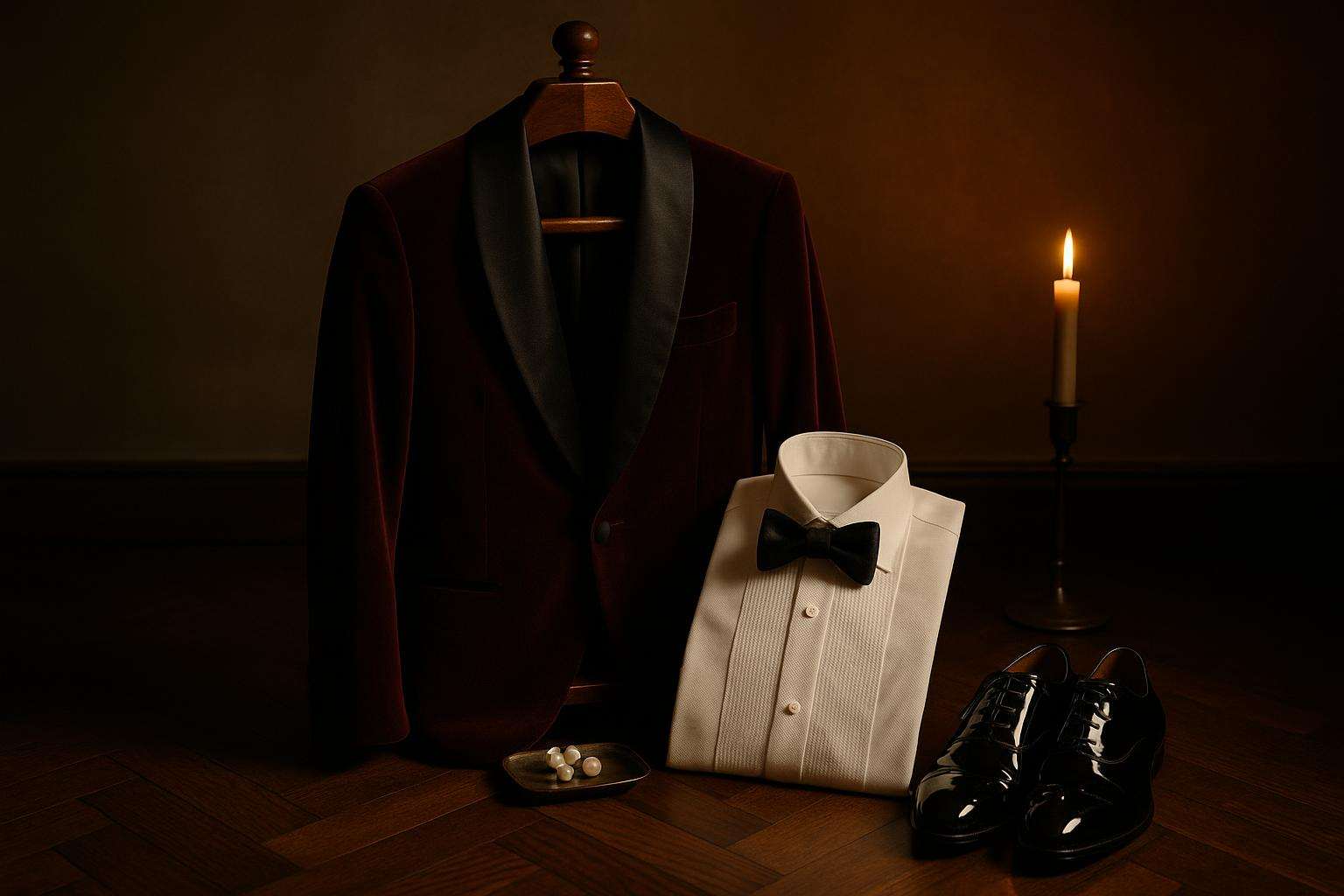
A velvet dinner jacket is correct — and can be the chicest thing he wears — for an evening wedding, in a deep colour (burgundy, midnight blue, or forest green), worn with a strictly classic black-tie frame: black formal trousers, white dress shirt, black bow tie, and polished black shoes. One velvet hero piece, everything else orthodox. Steam it, never iron it.
There is a moment, planning an evening wedding, when the standard black tuxedo starts to feel a touch expected — and someone wonders aloud whether he could wear velvet. The answer, happily, is yes. Velvet is not a gimmick or a costume when it is done properly; it is one of the oldest and most distinguished alternatives in formal menswear. The smoking jacket — the velvet jacket's direct ancestor — was conceived as eveningwear, and the velvet dinner jacket has carried that lineage into the present as a refined cold-weather and evening option. The whole art of wearing it well is knowing where it belongs and what must stay classic around it.
When is a velvet dinner jacket actually correct for a groom?
Velvet earns its place at evening weddings. The dinner jacket itself is an after-six garment, and the velvet version reads as a holiday or cold-weather variation of black tie rather than a daytime default. Gentleman's Gazette is explicit that ceremonies beginning after 6:00 p.m. commonly carry a black-tie expectation, and that velvet is a fully acceptable — sometimes chicer — alternative to the usual wool barathea. As Simon Cundey of the Savile Row house Henry Poole & Co. has put it, while barathea is the order of today, the velvet jacket is just as acceptable and, in some cases, smarter.
Two guardrails keep it on the right side of the line. First, an alternative jacket suits the less rigid end of formal — the reception, a private celebration — and every other element of the outfit must comply with proper black tie. Second, the experts counsel restraint: colored dinner jackets are popular with younger grooms, and in unschooled hands the dinner jacket can slip into a sophomoric gimmick. The remedy is simple, and it runs through everything below: let the velvet be the only liberty, and keep the rest immaculately classic.
Which velvet colour suits him — burgundy, midnight, or forest?
The authentic palette for a velvet jacket is dark and saturated — historically green, violet, burgundy, or blue. For a wedding, three colours do the most work:
| Colour | Mood | Best for |
|---|---|---|
| Burgundy / oxblood | Warm, romantic, rich against candlelight | Autumn & winter evening weddings |
| Midnight blue | Reads richer than true black under artificial light | The connoisseur's choice; photographs beautifully |
| Forest / bottle green | Distinctive without shouting | The groom who wants quiet individuality |
| Black | The most conservative; texture over colour | Strict black-tie venues |
Burgundy is the romantic, warm choice and flatters most complexions in candlelight; SuitSupply offers it in stretch cotton velvet. Midnight blue is the insider's pick because it reads as a deeper, richer black under the warm light of a reception — Tom Ford's midnight-blue velvet dinner jacket is the genre's benchmark. Forest green carries quiet individuality. What you want to avoid for a wedding is anything pale, bright, or novelty: that is where velvet stops looking formal and starts looking like fancy dress.
How does he style it so it reads black tie, not costume?
This is the part that decides everything. The velvet is the single statement; the frame around it stays orthodox. That means black formal trousers with a satin or braid stripe down the leg, a crisp white dress shirt with a pleated or Marcella front and double cuffs for cufflinks, a black self-tie bow tie, and black patent or highly polished oxford shoes (velvet evening slippers are permissible, but they announce themselves). The jacket's lapel should be silk-faced in a shawl or peak shape — shawl is the most traditional and arguably the smartest.
A few disciplines separate the polished groom from the costumed one. Do not match the bow tie to the pocket square — as the old etiquette has it, a gentleman's tie, square, and waist covering were never meant to share the same gene pool. Skip the velvet waistcoat and, for a wedding, skip velvet trousers too; black tuxedo trousers are the surer, more flattering call, and a head-to-toe velvet suit tips toward the theatrical. Let one accessory — a boutonnière, a pocket square, a pair of mother-of-pearl cufflinks — carry the personal note. GQ's black-tie guide shows just how far the genre can stretch in confident hands, but for a groom the safest, most photogenic version is a deep velvet jacket over an otherwise textbook black-tie kit.
What does it cost, and how does he care for it?
Velvet dinner jackets span a broad range. Accessible tailoring such as SuitSupply's Havana sits in roughly the four-to-five-hundred-dollar band; designer houses like Hugo Boss run from several hundred toward a thousand; luxury labels such as Tom Ford begin around two thousand and climb; and a bespoke Savile Row commission goes higher still. For most grooms, the accessible-to-designer tier delivers a jacket that looks remarkable in the photographs without an extravagant outlay.
Care is where velvet surprises people, and it matters because the jacket has to look its best for one long evening. The single rule: never iron velvet — direct heat crushes the pile and the damage is permanent. Steam it instead. Hold a handheld steamer about six inches from the fabric, or hang the jacket in a steamy bathroom for around thirty minutes before he dresses. Between wears, store it on a padded hanger inside a breathable cotton garment bag — never folded, and out of direct sunlight, which fades the colour — and brush it gently with a soft-bristled clothes brush to lift the pile and clear lint. Most accessible jackets are cotton velvet, which is more forgiving than silk, but the steam-not-iron rule holds across the board.
Worn this way — one deep, well-chosen colour, a classic black-tie frame, and a little care with the pile — a velvet dinner jacket gives the groom exactly what the right piece of formalwear should: he looks unmistakably like himself, on a very good evening, in photographs he will be glad to keep.
Frequently asked
Is a velvet dinner jacket appropriate for a wedding?
Yes — at an evening wedding, and styled with restraint. The dinner jacket is an after-six garment, and velvet is a long-accepted, even chic, alternative to the standard barathea. Gentleman's Gazette notes that ceremonies beginning after 6:00 p.m. commonly call for black tie, and that a velvet dinner jacket reads as a refined cold-weather or holiday variation. The single rule that keeps it correct: every other element of his outfit must comply with classic black tie. Save velvet for the reception and the evening; it is not a daytime or garden-wedding piece.
What colour velvet dinner jacket should the groom choose?
Stay in deep, saturated tones — the authentic smoking-jacket palette of burgundy, midnight blue, and forest (bottle) green. Burgundy is warm and romantic, ideal for autumn and winter; midnight blue photographs richer than true black under artificial light; forest green is distinctive without shouting. Black velvet is also correct and the most conservative choice. Avoid pale, bright, or pastel velvet for a wedding — it tips the look from formal toward costume. One deep hero colour, framed by classic black accessories, is the formula that flatters in photographs.
What does he wear with a velvet dinner jacket?
Keep everything else strictly black tie. Pair the velvet with black formal trousers carrying a satin or braid side stripe, a white dress shirt with a pleated or Marcella front and double cuffs for cufflinks, a black self-tie bow tie, and black patent or highly polished oxford shoes. Choose a silk-faced shawl or peak lapel on the jacket. Resist matching the bow tie to the pocket square, and skip a velvet waistcoat or velvet trousers for a wedding — the jacket alone is the statement, and the classic frame around it is what reads refined.
How much does a velvet dinner jacket cost?
It spans a wide range. Accessible tailoring such as SuitSupply's Havana dinner jacket in stretch cotton velvet sits in the roughly four-to-five-hundred-dollar band. Designer houses like Hugo Boss generally run several hundred up toward a thousand. Luxury labels such as Tom Ford, whose midnight-blue velvet dinner jacket is a benchmark of the genre, run two thousand dollars and up. Bespoke from a Savile Row house climbs higher still. For most grooms the accessible-to-designer tier delivers a jacket that photographs beautifully without an outsized cost.
How do you care for a velvet dinner jacket before the wedding?
Never iron velvet — direct heat crushes the pile permanently. Steam it instead, per The Laundress: hold a handheld steamer about six inches from the fabric, or hang the jacket in a steamy bathroom for around thirty minutes before dressing. Store it on a padded hanger inside a breathable cotton garment bag — never folded, and away from direct sunlight — and brush it gently with a soft-bristled clothes brush after each wear to lift the pile. Cotton velvet is more forgiving than silk, but the steam-not-iron rule always holds.
Can the groomsmen wear velvet dinner jackets too?
It works best when the groom alone wears velvet and the groomsmen wear classic black barathea dinner jackets, so the groom stands a half-step apart in the photographs. If you do want velvet across the party, keep it to a single shared deep colour, keep every other element identical and orthodox, and let the groom distinguish himself with a different accessory — a boutonnière or pocket square — rather than a different jacket. A line of mismatched velvet colours reads chaotic; one disciplined colour reads intentional.