Groom Attire
The White Dinner Jacket: Summer Black-Tie for the Bold Groom
Why the ivory dinner jacket is the most flattering thing a groom can wear in warm weather — and the small set of rules that keep it correct rather than costumey.
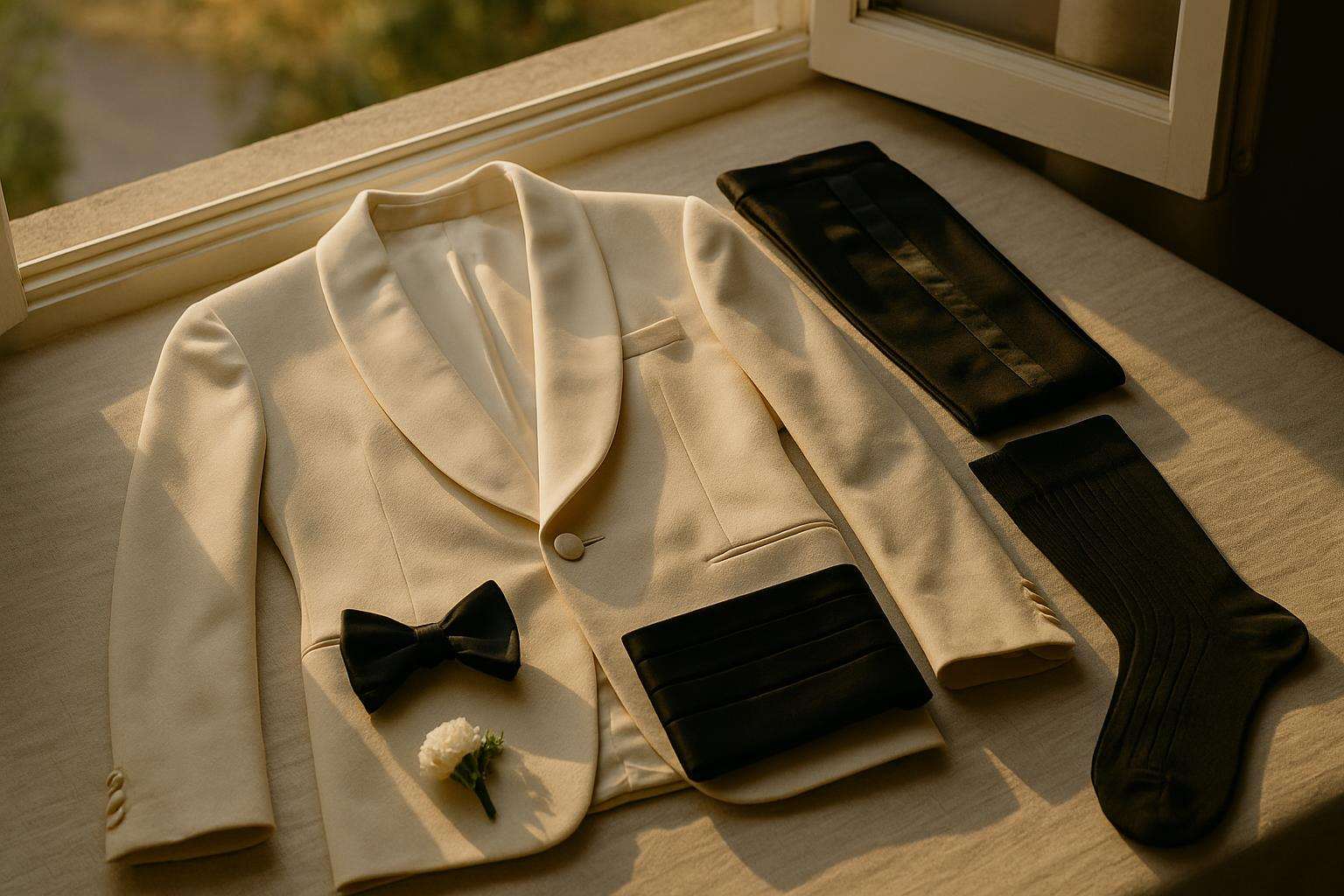
For a summer, warm-weather, or destination wedding — or any black-tie optional dress code — an ivory dinner jacket is a genuinely flattering, historically correct choice for your groom. Keep the lapel self-faced (no silk), shaped as a shawl or peak collar (never notch), and pair it with black evening trousers, a black bow tie, and a cummerbund. Stick to those rules and he looks elegant and intentional; break them and it slides toward costume.
There is a moment in almost every warm-weather wedding plan where someone asks the quiet question: does he have to wear a black tuxedo? If the day is in July, or on a terrace, or somewhere with palms in the photographs, the answer is a happy no. The white dinner jacket — worn in ivory, styled with care — is one of the most flattering things a groom can put on, and it is far older and more correct than its showy reputation suggests. This is how to wear it well, and where to find a good one.
Where did the white dinner jacket come from, and is it really black tie?
The pale jacket is not a novelty. It emerged in the early 1930s as a way for well-traveled men to keep the formality of black tie without the heavy dark wool in tropical heat. Understood properly, it is not a less-formal alternative to black tie — it is the warm-weather member of the black-tie family, a substitute for the dark dinner jacket when the climate calls for it. Gentleman's Gazette traces its traditional home to formal occasions in the tropics year-round, and to the American summer season — country-club dances, yacht-club evenings, open-air celebrations. A summer or destination wedding sits squarely in that tradition.
So the rule for your groom is simple. If the invitation reads a plain black tie for an evening indoors in cooler months, default to black or midnight. But for a summer, warm-weather, or destination wedding — or a black-tie optional code — the white dinner jacket is not just permitted, it is arguably the more considered choice.
Why is it so flattering on a groom specifically?
Three reasons, and they are worth knowing because they make the case better than any trend will. First, light: a pale jacket lifts the face and photographs beautifully under both natural daylight and warm evening lighting, where a black tux can read flat. Second, harmony: brides so often wear ivory or off-white that a soft ivory jacket over black trousers reads as a matched pair rather than a clash — present without competing. Third, comfort: once evening temperatures climb past the mid-70s, the pale cloth reflects heat and keeps him noticeably cooler than dark wool in humidity. The Knot and The Black Tux both make the point that a groom in ivory tends to look celebratory and a little distinctive — exactly the register you want on the man at the center of the day.
White or ivory — which one should he choose?
Ivory or cream, almost without exception. The garment is called a "white" dinner jacket out of habit, but the desirable color has always been a soft off-white. Pure, optic white historically belonged to military mess dress and to the jackets of waiters and bartenders — not the association any groom wants in his photographs. Ivory also flatters more skin tones under warm light and sits gently beside a bride's gown. When you are looking at swatches or product photos, pick the warmer, creamier tone over the cold bright one every time.
How do you style a white dinner jacket correctly?
This is where a small checklist saves the whole look. From the waist down, treat it exactly like a tuxedo; the only things that change are the color and cloth of the jacket itself.
| Element | Do | Avoid |
|---|---|---|
| Jacket color | Ivory / cream / off-white | Stark optic white |
| Lapel facing | Self-faced (same cloth, no silk) | Black satin lapel on a white body |
| Lapel shape | Shawl collar (ideal) or peak | Notch lapel |
| Trousers | Black or midnight, satin side stripe | Matching white trousers |
| Waist | Black cummerbund | A heavy waistcoat (too warm) |
| Neckwear | Black silk bow tie | A long tie |
| Shoes & socks | Patent pumps or black oxfords, black silk socks | Brown shoes, no-show socks |
| Pocket square | Softly contrasting; or a boutonnière for color | Plain white (too close, not matching) |
The single most important line in that table is the lapel facing. Unlike a black tuxedo, a white dinner jacket lapel is self-faced — cut from the same cloth as the jacket, with no silk satin laid over it. Off-the-rack jackets that stitch a black satin lapel onto a white body look wrong to anyone who knows the garment, and the classic style authorities advise against them. As for shape, the shawl collar suits the slightly relaxed character of the jacket best, peak is perfectly correct, and a notch lapel turns it into an ordinary sport coat. The cummerbund, not a waistcoat, covers less of the torso and keeps him cooler — which is the entire reason this jacket exists.
Should the groom rent or buy his white dinner jacket?
It comes down to how often he will wear black tie after the wedding. If this is a one-time affair, renting is the sensible path: a house like The Black Tux offers an ivory dinner jacket with silk peak lapels and a single-button closure, ships it about ten days before the event so there is time to check the fit, and its own 2026 figures put a typical tuxedo rental in the $150 to $300 range. If he is the sort of man invited to galas, fundraisers, and other black-tie evenings, buying earns its keep: SuitSupply's off-white "Havana" dinner jackets in Italian summer linen-cotton or all-season wool run roughly $599 to $649 to own, which is a few rentals' worth of cost and a lifetime of summers. Either way, leave time for one real alteration — a clean shoulder and a trim sleeve are what make ivory look bespoke rather than borrowed.
Dressed correctly — ivory, self-faced, black from the waist down — the white dinner jacket gives your groom something rare: a black-tie look that is unmistakably his, suited to the warmth of the day, and impossible to mistake for anyone else in the room. That is exactly what you want him to feel walking toward you.
Frequently asked
Is a white dinner jacket appropriate for a groom at a black-tie wedding?
It depends on the season and the wording. If the invitation says plain black tie for an evening indoors, the safe default is a black or midnight tuxedo. But for a summer, warm-weather, or destination wedding — or a black-tie optional dress code — a white (ivory) dinner jacket is entirely correct and reads as black-tie-appropriate. It is, after all, the historical warm-weather member of the black-tie family. As The Black Tux explains, it is a favorite precisely for summer and outdoor celebrations, where it photographs beautifully and keeps him cooler than dark wool.
Should the groom choose white or ivory?
Ivory or cream — almost never stark white. Although the garment is universally called a "white dinner jacket," the desirable color has always been a soft off-white. Gentleman's Gazette notes that pure white was historically reserved for military mess dress and the jackets of waiters and bartenders — not the association any groom wants. Ivory also flatters skin under warm evening lighting and sits in gentle harmony beside a bride's ivory or off-white gown, rather than competing with it. If you are choosing between swatches, pick the warmer, creamier one.
What does he wear with a white dinner jacket?
Treat it exactly like a tuxedo from the waist down: black (or midnight) evening trousers with a satin side stripe, never matching white trousers. Up top, a black silk bow tie and a cummerbund rather than a waistcoat — the cummerbund covers less and keeps him cooler, which is the whole point of a warm-weather jacket. Finish with black silk over-the-calf socks and patent opera pumps or plain black oxfords. For the pocket square, skip plain white (too close to the jacket) in favor of something softly contrasting, or let the boutonnière carry the color.
Can a guest wear a white dinner jacket if the groom is wearing one?
This is the one real courtesy to mind. The "only the couple wears white" rule applies to dresses far more than to menswear, so an ivory dinner jacket on a male guest at a warm-weather black-tie event is generally fine. But if your groom is wearing one, he should get the spotlight — a thoughtful guest will choose a black or midnight tux instead so he is not visually doubled. If you are coordinating the wedding party, it is worth a quiet word to close friends and the fathers so the groom's ivory jacket stays his alone on the day.
Why does the lapel matter so much on a white dinner jacket?
Because it is the detail that separates a correct jacket from a costume. Unlike a black tuxedo, the white dinner jacket lapel is self-faced — made from the same cloth as the jacket, with no silk satin facing. Off-the-rack jackets with a black satin lapel stitched onto a white body are historically incorrect, and Gentleman's Gazette advises against them. As for shape: a shawl collar suits the jacket best and a peak lapel is perfectly acceptable, but a notch lapel makes it read as an ordinary sport coat and should be avoided.
Is it better to rent or buy a white dinner jacket?
Rent if this is a one-off; buy if he is the kind of man invited to several formal events a year. Renting from a house like The Black Tux keeps the cost modest — typical tuxedo rentals run roughly $150 to $300 — and the jacket arrives about ten days early so there is time to adjust the fit. To own, SuitSupply's off-white "Havana" dinner jackets in Italian summer linen-cotton or all-season wool run around $599 to $649, which pays for itself across a few black-tie seasons.