Accessories
Groom Accessories: The Complete Men's Wedding Checklist
A head-to-toe checklist of every accessory he wears beyond the suit — tie, pocket square, cufflinks, belt, watch, shoes, socks, boutonnière, and band — with real brands, real prices, and the one rule that ties it all together.
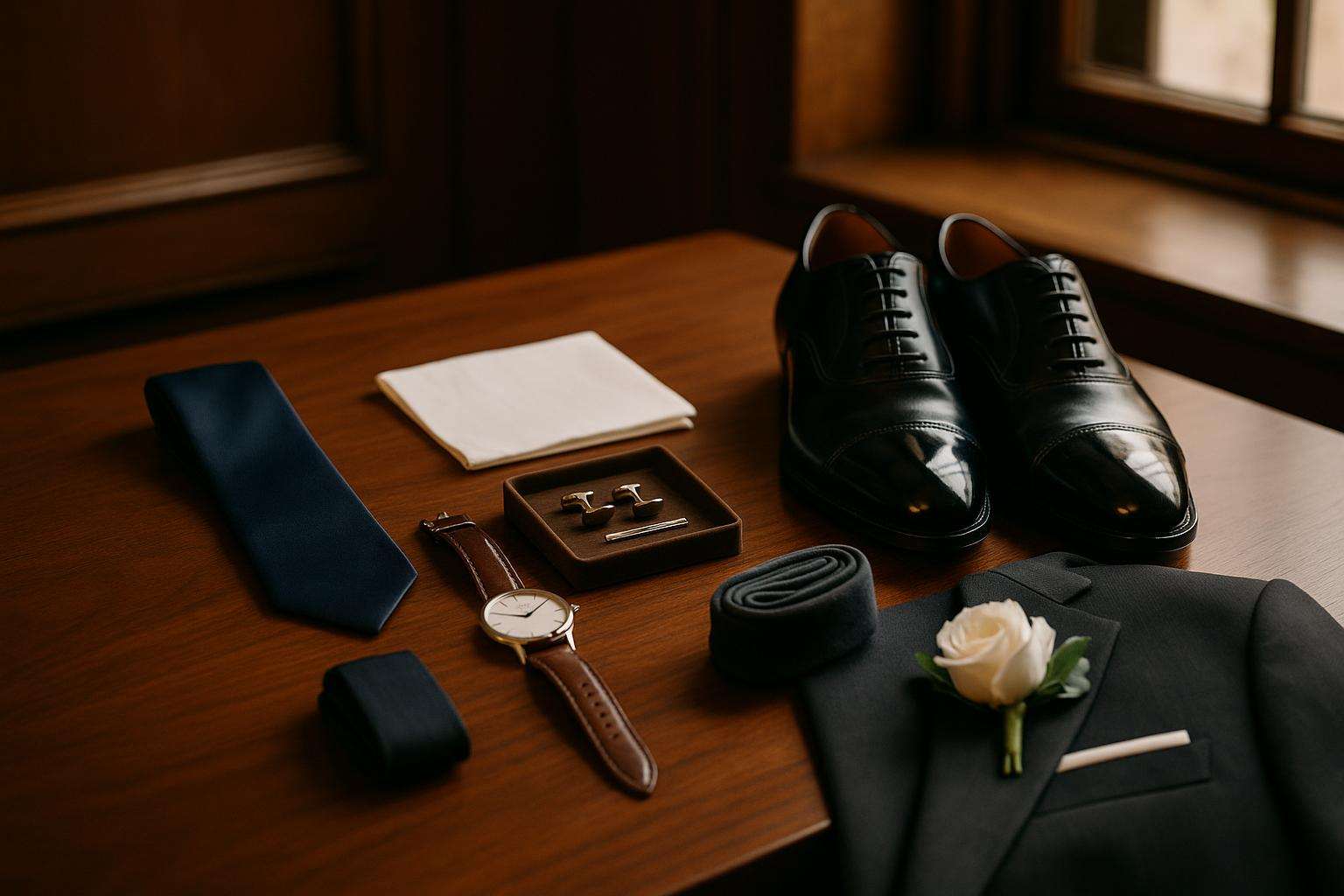
groom accessories checklistgroom wedding accessoriesgroom tie and pocket squaregroom dress shoesmen's wedding band
The quick verdict
A head-to-toe checklist of every accessory he wears beyond the suit — tie, pocket square, cufflinks, watch, shoes, socks, boutonnière, and band — with real brands and the one rule that ties it together.
- Best overall
- Neckwear + a complementary pocket square — The tie sets the formality and the square finishes the lapel; get this pairing right (complement, never match) and the rest of the look falls into place.
- Best value
- A coordinated set from The Tie Bar or The Black Tux — Tie, bow tie, and matching pocket squares in the ~$10–$55 range coordinate the groom and the whole party without a custom budget.
- Best for The keepsake that outlasts the day
- Seiko Presage Cocktail Time watch (~$319) — An automatic dress watch he will actually wear for years — the one accessory worth treating as an investment, with the case tone matched to his cufflinks.
How we evaluated
This checklist was built from established menswear editorial and the real product ranges of the brands cited. Each accessory is treated as a line item with a single job, a real brand anchor, and a current 2026 price range checked against official brand and retailer pages. Items are ordered by how the look is built — neckwear first, the band last. No brand paid for placement; an honest caveat is included for every line so you know where each choice can go wrong.
- Coordination logic. Whether the accessory follows the two governing rules — pocket square complements (never matches) the tie, and watch, cufflinks, tie bar, and buckle share one metal tone.
- Formality fit. Whether the choice suits the wedding's dress code — bow tie and patent leather for black tie, textured necktie and matte leather for daytime or outdoor — rather than fighting it.
- Real availability and price. Each line is anchored to a real brand and a current price range from official channels, spanning accessible to investment tiers so the checklist works on any budget.
- Lead time and break-in. Whether the piece needs ordering weeks ahead (custom cufflinks, sized bands) or breaking in before the day (shoes), so nothing derails the morning of.
Rating scale: 1–5 in 0.5 increments. 5.0 = a non-negotiable, get-it-right line that defines the look. 4.0–4.5 = important with a clear best-practice rule. 3.0–3.5 = situational or optional depending on dress code and shirt. Ratings reflect each item's weight in the overall checklist, not product quality alone.
Last verified .
At a glance
| # | Name | Rating | Best for | Pricing |
|---|---|---|---|---|
| 1 | Tie or Bow Tie | 5.0 | Every groom — the first and most consequential accessory decision, made to match the wedding's dress code | ~$25–$55 |
| 2 | Pocket Square | 4.5 | Every groom wearing a jacket — the cheapest accessory with the largest effect on how considered the look reads | ~$10–$20 |
| 3 | Cufflinks | 4.0 | Any groom in a French-cuff shirt — essential for formal weddings, skippable only with a barrel-cuff shirt | ~$30–$120 |
| 4 | Belt or Suspenders | 4.0 | Every groom — a belt for a standard suit, suspenders or side adjusters for a tuxedo | ~$40–$90 |
| 5 | Watch | 4.0 | Grooms who want one investment accessory that survives the day and earns its place in the photographs | ~$200–$650 |
| 6 | Dress Shoes | 4.5 | Every groom — with a black cap-toe oxford the safe formal default and patent leather reserved for black tie | ~$250–$425 |
| 7 | Dress Socks | 3.5 | Every groom — coordinated to the suit for the conservative look, or to the palette for a subtle flourish | ~$12–$25 |
| 8 | Boutonnière | 3.5 | Every groom — coordinated with the florist so it echoes the bouquet and differs subtly from the groomsmen | Usually included with florist package |
| 9 | Wedding Band | 5.0 | Every groom — tungsten for durability and value, gold or platinum for a resizable traditional ring | From ~$135 (tungsten) |
Tie or Bow Tie
The piece that sets the tone — a bow tie for black tie, a textured necktie for everything more relaxed.
Editor's pick
Neckwear is the first accessory decision because it sets the formality of the entire look. The rule is simple: a black-tie evening wedding calls strictly for a bow tie, traditionally in silk, while a semi-formal, daytime, or outdoor wedding opens the door to a necktie in a textured fabric like knit, linen, or wool. The Black Tux carries both pre-tied and self-tie silk and velvet bow ties built for weddings, with matching neckwear available for the whole party, and offers groomsmen 20% off when they buy their outfits. The Tie Bar's groom checklist is the accessible anchor, with silk and linen ties commonly in the $25–$55 range. The coordination move that matters most: the groom should share the color family of his groomsmen but stand visibly apart, usually by going a shade darker or richer, or by choosing a bow tie where the party wears neckties. If he has never tied a bow tie, a pre-tied adjustable style is no longer a compromise — the modern silk versions sit perfectly centered and read as deliberate. Whatever he chooses, this is the one accessory worth deciding first, because the pocket square, the metals, and even the boutonnière all take their cue from it.
Strengths
- Sets the formality of the whole look — every other accessory takes its cue from the tie
- Bow tie for black tie, textured necktie for daytime or outdoor gives a clear dress-code rule
- Real coordinated programs at The Black Tux and The Tie Bar let the groom and party match affordably
Weaknesses
- It is easy to match the groomsmen too closely; the groom must deliberately go a shade richer or switch tie style to stand apart
- Best for
- Every groom — the first and most consequential accessory decision, made to match the wedding's dress code
- Pricing
- ~$25–$55
Source: The Black Tux — Men's Formal Accessories · Visit Tie or Bow Tie
Pocket Square
Complement the tie, never match it — and a white linen square is the elegant default.
Best value
The pocket square is the accessory most often gotten wrong, and the rule fixing it is one line: complement the tie, never exactly match it. Pull a secondary color from the tie's pattern for the square rather than buying a matched tie-and-square set, which menswear editors agree reads cheap and obvious in photographs. Gentleman's Gazette places the pocket square fourth in the outfit-building order — chosen after the tie has set the color accents — and notes that for more formal weddings, a white linen or silk square echoing the shirt is the safest and most elegant default. Fabric tracks formality: silk for the most formal evenings, linen and cotton for crisp daytime looks, wool for autumn and winter. The fold is the groom's quiet point of difference from his groomsmen — a structured presidential or one-point fold for him, a relaxed puff for the party. One coordination note that protects the photographs: if he is wearing both a pocket square and a boutonnière, keep the square a solid neutral like white or cream so the lapel flower carries the visual interest and the chest does not read as busy. At roughly $10–$20 for a good linen square from The Tie Bar, this is the highest-impact, lowest-cost line on the entire checklist.
Strengths
- Highest visual impact for the lowest cost — a great linen square is roughly $10–$20
- The complement-don't-match rule is simple and instantly elevates the look
- The fold gives the groom an easy, free way to distinguish himself from the groomsmen
Weaknesses
- Pairing a square that exactly matches the tie is the single most common groom styling mistake and undoes the effect entirely
- Best for
- Every groom wearing a jacket — the cheapest accessory with the largest effect on how considered the look reads
- Pricing
- ~$10–$20
Source: Gentleman's Gazette — How To Combine A Pocket Square With A Tie · Visit Pocket Square
Cufflinks
Required with French cuffs — conservative metal, matched to the watch, ordered early if engraved.
Cufflinks are required, not optional, the moment the groom's shirt has French (double) cuffs, which a formal wedding shirt usually does. The editorial guidance is consistent and restrained: choose a simple, solid-metal style and match its metal to the watch and any tie bar, because mixed metals are the detail that quietly makes a look feel disjointed. Cufflinks can be silver, gold of any color, or another solid metal, and may carry conservative stones — but stay away from logos, novelty shapes, or miniatures, which read too whimsical for the occasion. Personalized or engraved cufflinks are one of the most popular sentimental touches, often carrying the wedding date or a monogram, and they make a classic gift from the bride or from the groom to his best man. The one logistical trap is lead time: custom and engraved cufflinks routinely take four to six weeks to produce, so this is a line to order early rather than the week before. For a groom who does not want a custom pair, a clean pair of solid silver or gold knots or bars in the $30–$120 range covers it. Because cufflinks set the metal tone that the watch and tie bar must follow, decide them in tandem with the watch rather than in isolation.
Strengths
- A natural place for a sentimental, engraved keepsake — the date or a monogram
- Sets the metal tone the watch and tie bar follow, anchoring the whole metal scheme
- Conservative solid-metal pairs are widely available from $30–$120
Weaknesses
- Custom or engraved pairs take four to six weeks, so leaving them late is the most common scheduling miss
- Best for
- Any groom in a French-cuff shirt — essential for formal weddings, skippable only with a barrel-cuff shirt
- Pricing
- ~$30–$120
Source: OurVows — The Ultimate Groom Accessories Guide for 2025 & 2026 · Visit Cufflinks
Belt or Suspenders
Choose one, never both — and tuxedo trousers take suspenders, not a belt.
This is the shortest rule on the checklist and the one most often broken: a belt or suspenders, never both. The two pieces do the same job — holding the trousers — and wearing them together looks redundant and over-thought. For a standard suit, a slim leather belt whose color and finish match the shoes is the clean default, and its buckle joins the metal scheme alongside the watch and cufflinks. For a tuxedo, the question answers itself: formal tuxedo trousers are designed without belt loops, so the correct choices are side adjusters built into the waistband or a pair of suspenders (braces), which also give the cleaner vertical line that black tie rewards. Suspenders that button inside the waistband read more formal and sit better than clip-on versions, and because they are hidden under the jacket for most of the day, they are a comfort upgrade as much as a style one. If the groom is choosing a belt, keep it understated — a plain leather strap with a simple buckle in the same tone as his other metals, roughly $40–$90 — rather than anything with heavy hardware or contrast stitching that competes with the suit. The single decision here is binary, and getting it right is free; it is purely a matter of not doubling up.
Strengths
- Suspenders give the clean vertical line that tuxedos and belt-loop-free trousers require
- A belt's buckle slots neatly into the watch-and-cufflinks metal scheme when matched
- The core rule — one, never both — is free to get right and instantly looks more considered
Weaknesses
- Wearing a belt with suspenders, or a belt with belt-loop-free tuxedo trousers, is a common and easily avoided error
- Best for
- Every groom — a belt for a standard suit, suspenders or side adjusters for a tuxedo
- Pricing
- ~$40–$90
Source: Hockerty — Your Wedding Suit Checklist for the Groom · Visit Belt or Suspenders
Watch
The accessory that outlasts the day — a dress watch in the tone of his cufflinks.
Of everything on this checklist, the watch is the one piece the groom keeps and wears for years, which makes it the line most worth treating as an investment. The rule that ties it to the rest of the look is the metal rule: the watch's case should share the tone of the cufflinks, tie bar, and buckle — silver-toned with cool navy or grey suits, gold-toned with warm tan or earth tones. A handful of dress watches recur across enthusiast editorial as the sweet spot for a groom under $500. The Seiko Presage "Cocktail Time" (around $319) pairs an automatic movement with a 40.5mm case and a dial designed to evoke an upscale reception — arguably the best value in the category. Tissot's Le Locle and Classic Dream sit in the $200–$300 band with Swiss quartz precision, while the Tissot PRX (~$650) is the contemporary statement option. The Timex Marlin Automatic (~$200–$250) and the Orient Bambino (under $300) round out the dressy-but-wearable picks. A fine watch is also a classic gift — from a parent to a son-in-law, or exchanged between the couple. The only caveat is restraint: a chunky dive watch fights a tailored suit, so keep the case slim, the strap leather or a simple bracelet, and the tone matched to the metals already chosen.
Strengths
- The one accessory he keeps and wears for years — genuine keepsake value
- Strong automatic and quartz options under $500 (Seiko Presage ~$319, Timex Marlin ~$225)
- A natural and classic wedding gift between the couple or from a parent
Weaknesses
- A bulky sport or dive watch fights a tailored suit; the case must stay slim and the tone must match the cufflinks
- Best for
- Grooms who want one investment accessory that survives the day and earns its place in the photographs
- Pricing
- ~$200–$650
Source: Teddy Baldassarre — The 48 Best Automatic Watches Under $500 · Visit Watch
Dress Shoes
A black cap-toe oxford is the formal default — and they must never be brand-new on the day.
The default formal wedding shoe is a black cap-toe oxford in polished leather, and the rule no groom should break is that the shoes must never be brand-new on the wedding day. New dress shoes blister, and a groom limping through the reception is a self-inflicted wound — the fix is to break them in indoors for short stretches over several weeks, walking different surfaces to test grip and comfort, always with the dress socks he will actually wear. For a shoe built to last, Allen Edmonds is the heritage anchor: the American-made, Goodyear-welted Park Avenue and Fifth Avenue cap-toe oxfords are the canonical groom picks, listed around $425 but frequently discounted into the $250s, and because they are recraftable, a well-kept pair outlives many weddings to come. For the most formal black-tie weddings, a high-gloss patent leather oxford or a sleek whole-cut is the dressier move. The groom can subtly distinguish his shoes from the groomsmen's with a higher-polish finish or a touch of embossed leather, but the silhouette should stay classic. Shoes also set the leather tones for the belt, so choosing them early lets the belt match cleanly. Whatever the budget, the two non-negotiables are a closed-lace oxford silhouette for formality and a real break-in window before the day.
Strengths
- Black cap-toe oxford is a foolproof, photograph-proof formal default
- Allen Edmonds' recraftable Goodyear-welted models (Park Avenue, Fifth Avenue) last well beyond the wedding
- A higher-polish or whole-cut finish lets the groom subtly out-dress the groomsmen
Weaknesses
- Wearing brand-new shoes on the day risks blisters; they require a multi-week break-in that grooms often skip
- Best for
- Every groom — with a black cap-toe oxford the safe formal default and patent leather reserved for black tie
- Pricing
- ~$250–$425
Source: Allen Edmonds — Men's Wedding Shoes & Groom Dress Shoes · Visit Dress Shoes
Dress Socks
Long enough to never show skin when he sits — coordinated to the suit, not the shoes.
Socks are the accessory grooms most often treat as an afterthought, and the one functional rule is non-negotiable: they must be long enough — over-the-calf is ideal — that no bare leg shows when he sits down, crosses his legs, or kneels at the altar. A flash of shin between trouser cuff and sock is the kind of detail that quietly cheapens an otherwise sharp look in the seated ceremony photographs. Beyond length, socks are where a groom gets a small, low-risk dose of personality. The conservative choice is to coordinate the sock color to the suit, which keeps the leg line unbroken and reads as polished. The expressive choice — a bold color or a subtle pattern picking up the pocket square or the wedding palette — is a popular and forgiving way to add a thoughtful touch, since the socks only show in glimpses. The one combination to avoid is matching the socks to the shoes, which flattens the leg and looks dated; tie them to the trousers instead. Good over-the-calf dress socks run roughly $12–$25 a pair, making this another high-impact, low-cost line. Many grooms also buy a coordinated set for the groomsmen as a small uniforming detail and an easy gift, which is a tidy way to add cohesion to the party without a large outlay.
Strengths
- Over-the-calf length prevents the bare-shin flash that cheapens seated ceremony photographs
- A low-risk place for personality — a pattern picking up the pocket square or palette
- Inexpensive (~$12–$25) and easy to buy as a coordinated set for the groomsmen
Weaknesses
- Short socks that expose skin when seated, or socks matched to the shoes, are common mistakes that undercut the look
- Best for
- Every groom — coordinated to the suit for the conservative look, or to the palette for a subtle flourish
- Pricing
- ~$12–$25
Source: OurVows — The Ultimate Groom Accessories Guide for 2025 & 2026 · Visit Dress Socks
Boutonnière
The lapel flower, usually from the florist — keep the pocket square plain so it can shine.
The boutonnière is the one accessory on this checklist the groom usually does not buy himself — it is typically supplied by the wedding florist and included in most floral packages, coordinated to the bridal bouquet and the overall flower palette. That makes it a coordination item rather than a shopping item, but it carries two styling rules worth knowing. First, if the groom is wearing both a pocket square and a boutonnière on the same lapel area, keep the pocket square a solid neutral — white or cream — so the flower carries the visual interest and the chest does not read as busy or competing in the portraits. Second, the boutonnière distinguishes the groom from his groomsmen by design: the groom's is traditionally slightly larger or a different bloom, often echoing a flower from the bridal bouquet, while the groomsmen wear a simpler, uniform version. Practically, it is pinned on just before the ceremony — stem down, on the left lapel, through the buttonhole if the jacket has a working one — and a second fresh boutonnière is a smart hedge for a long, warm day, since real flowers wilt. Because it is florist-supplied and palette-driven, the groom's main job is simply to confirm with the florist that his differs subtly from the party's and to coordinate the pocket square around it.
Strengths
- Usually included with the florist package — little to buy and palette-coordinated by default
- Naturally distinguishes the groom from groomsmen via a larger or different bloom
- Ties the groom's look directly to the bridal bouquet and the wedding's flower palette
Weaknesses
- Real flowers wilt over a long warm day; a fresh backup and correct just-before-ceremony pinning are needed
- Best for
- Every groom — coordinated with the florist so it echoes the bouquet and differs subtly from the groomsmen
- Pricing
- Usually included with florist package
Source: OurVows — The Ultimate Groom Accessories Guide for 2025 & 2026 · Visit Boutonnière
Wedding Band
The point of the whole day — sized exactly right and chosen to suit how he lives.
Editor's pick
The wedding band is the only accessory on this list that is not really an accessory — it is the reason for the day — and it is the one to get exactly right. The first decision is metal and durability matched to how he actually lives. Tungsten has become one of the most popular men's choices because it is exceptionally hard, scratch-resistant, low-maintenance, and far more affordable than precious metals: Manly Bands, founded in 2016 and now trusted by more than 800,000 couples, prices tungsten bands from around $135 with a lifetime manufacturing warranty, and offers a Build-Your-Own-Band tool plus distinctive inlays like carbon fiber, Koa wood, and black-plated finishes. The single critical caveat with tungsten is that its hardness makes resizing impossible, so the size must be measured accurately from the start — ideally with a professional sizing rather than a guess. Grooms who want a resizable, traditional option lean to gold or platinum at a higher price; those who work with their hands often prefer tungsten, titanium, or silicone for the gym and job site. Width is a personal call — narrower reads classic, wider reads modern — and comfort-fit interiors are worth choosing for an everyday ring. On the day itself, the band lives in the inside jacket pocket or with the best man until the ceremony. Order it early enough to confirm sizing and fix any issue, because this is the one accessory there is no improvising on the morning of.
Strengths
- Tungsten offers durability and scratch resistance at a fraction of gold or platinum (Manly Bands from ~$135)
- Build-Your-Own-Band and distinctive inlays let him choose a ring that suits how he lives
- Lifetime manufacturing warranty and a huge installed base make the category low-risk
Weaknesses
- Tungsten cannot be resized, so exact professional sizing up front is essential — a guess can mean reordering
- Best for
- Every groom — tungsten for durability and value, gold or platinum for a resizable traditional ring
- Pricing
- From ~$135 (tungsten)
Source: Manly Bands — Tungsten Wedding Bands for Men · Visit Wedding Band
Frequently asked
What accessories does a groom need on his wedding day?
A groom needs a short, fixed set of accessories beyond the suit: neckwear (a tie or bow tie), a pocket square, cufflinks if his shirt has French cuffs, an optional tie bar, a belt or suspenders, a watch, dress shoes, dress socks, a boutonnière (usually supplied by the florist), and his wedding band. A black-tie evening wedding calls strictly for a bow tie, while daytime and outdoor weddings allow a textured necktie. The two rules that tie everything together are simple: the pocket square should complement — never exactly match — the tie, and the watch, cufflinks, tie bar, and belt buckle should all share a single metal tone.
Do the groom's accessories need to match the groomsmen?
They should coordinate but not be identical. The standard approach is for the groom to share the same color family as his groomsmen while standing visibly apart — most often by going a shade darker or richer, by wearing a bow tie when the party wears neckties, or by choosing a more elaborate pocket-square fold and a slightly larger or different boutonnière. The goal is a party that reads as one cohesive group with the groom clearly at its center. Matching everything exactly makes the groom disappear into the lineup, which is the opposite of what the photographs should show.
How far in advance should a groom order his accessories?
Begin accessory planning three to four months before the wedding. That window matters because the genuinely custom pieces take time: engraved cufflinks routinely need four to six weeks, coordinated or dyed neckwear for the whole party needs ordering ahead, and a wedding band — especially tungsten, which cannot be resized — must be sized accurately and ordered with margin to fix any issue. It also leaves time to break in the dress shoes. The night before, lay everything out together, steamed and polished, with a few blister pads, so the morning is calm rather than a scramble.
What is the rule for matching metals in a groom's accessories?
The metal rule is the single guideline that makes a groom's accessories look intentional: his watch, cufflinks, tie bar, and belt buckle should all share one metal tone. Silver or platinum tones suit cool-colored suits like navy, grey, and black, while gold or rose gold flatters warm suits in tan, emerald, or terracotta. As Gentleman's Gazette notes, mixing a silver tie clip with gold cufflinks looks disjointed. A related proportion rule: a tie bar should span about three-quarters of the tie's width and never sit wider than the tie itself.
Should the groom's pocket square match his tie?
No — the pocket square should complement the tie, never exactly match it. Buying a matched tie-and-square set reads cheap and obvious in photographs. The better move is to pull a secondary color from the tie's pattern for the square, or to choose a crisp white linen square that echoes the shirt, which is the safest and most elegant default for a formal wedding. Fabric should track formality — silk for the most formal evenings, linen or cotton for daytime. If the groom also wears a boutonnière, keeping the pocket square a solid neutral lets the lapel flower carry the visual interest without the chest looking busy.
What kind of shoes and watch should a groom wear?
For most weddings, a polished black cap-toe oxford is the formal default; high-gloss patent leather is the dressier choice for black tie. Allen Edmonds' recraftable Park Avenue and Fifth Avenue oxfords (listed around $425, often discounted) are canonical heritage picks, but the firm rule for any pair is to break them in indoors over several weeks — never wear new shoes on the day. For the watch, a slim dress watch in the same metal tone as the cufflinks works best; strong sub-$500 options include the Seiko Presage Cocktail Time (~$319), the Timex Marlin Automatic (~$225), and the Orient Bambino (under $300). Keep the case slim so it does not fight a tailored suit.