Accessories
Oxford vs. Derby: Choosing Your Wedding Dress Shoes
The closed-versus-open lacing distinction, a clear formality ranking, and how each shoe pairs with his tuxedo or suit — grounded in real brands.
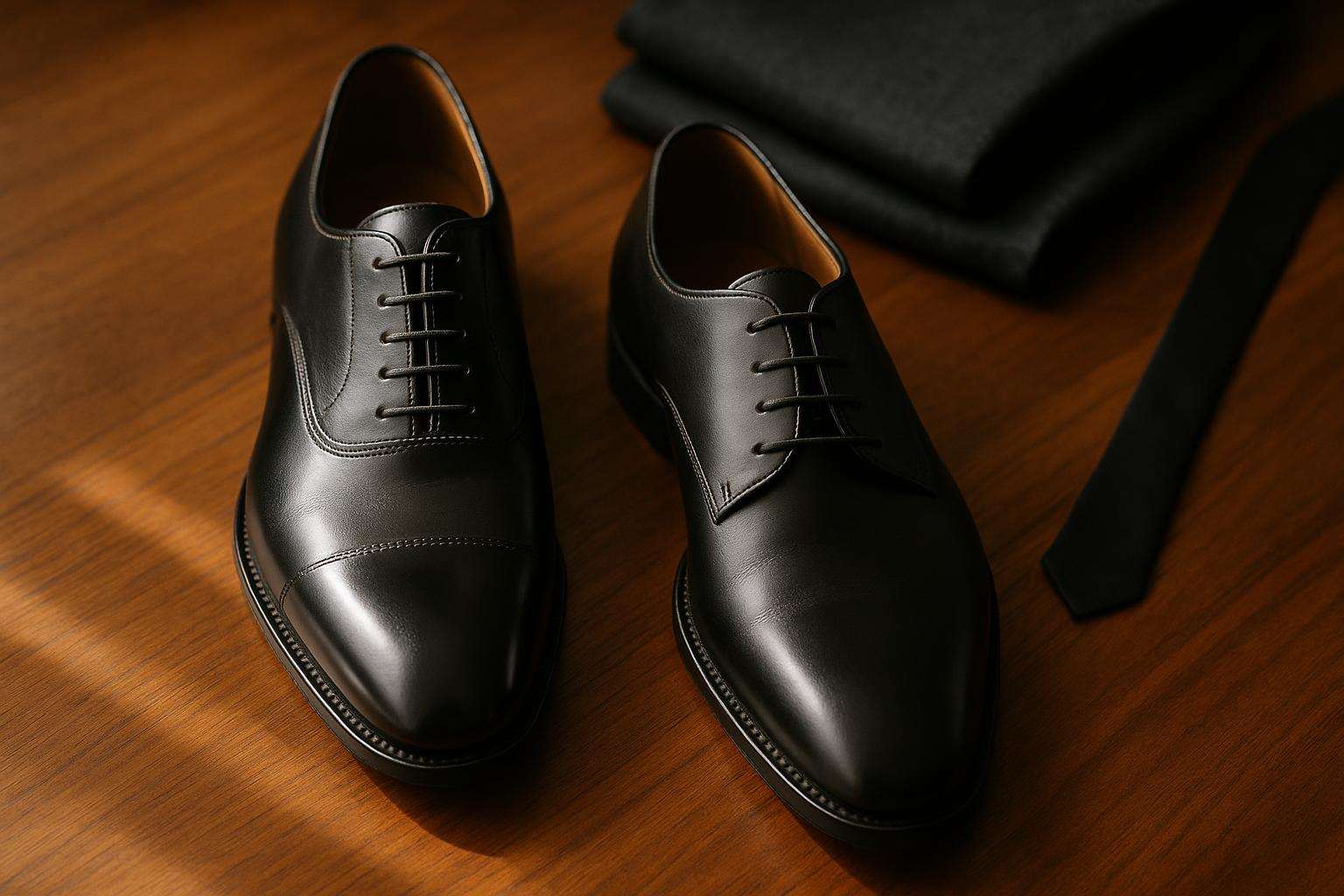
An Oxford has closed lacing — the leather facings are stitched under the front of the shoe, so they pull tight and nearly touch. That sealed line makes it the most formal lace-up and the classic wedding shoe. A Derby has open lacing — the facings sit on top and fan apart — which reads a half-step more relaxed and fits a wider foot. For a formal or black-tie wedding, choose a plain or cap-toe black Oxford; for a relaxed daytime celebration, a dark Derby is genuinely correct and more comfortable.
When you and he start shopping for wedding shoes, the words come at you fast — Oxford, Derby, Balmoral, Blucher, cap-toe, wholecut — and most of them describe the same two shoes. Strip the jargon away and there is really only one decision that matters, and it is hiding in plain sight on the top of the shoe. Get that one thing right and everything else falls into place. This is the distinction worth understanding before he spends a few hundred dollars on the pair he will stand in, dance in, and keep in the photographs forever.
What is the actual difference between an Oxford and a Derby?
The defining difference is the lacing construction — not the toe shape, the color, or the price. On an Oxford (Americans often call it a Balmoral), the eyelet panels known as the facings are stitched underneath the vamp, the front of the upper. When the shoe is laced, the two sides draw together and almost meet, producing a slim, closed, V-shaped throat and an unbroken line over the instep. That sealed silhouette is precisely what makes the Oxford the sleekest, most formal lace-up a man owns.
A Derby (its close cousin the Blucher is near-identical) works the other way around: the facings are stitched on top of the vamp, so the two flaps sit open and independent, fanning apart above the laces. That open throat does two useful things — it gives more room across the instep, which is kinder to a high or wide foot and to orthotics, and it reads a touch more relaxed than the buttoned-up Oxford. As the menswear house Cobbler Union puts it, the Oxford is the dressier shoe by construction; the Derby is the more versatile one.
Which is more formal — and which belongs at a wedding?
Here is the formality ladder almost every shoemaker agrees on, most formal first:
| Shoe | Lacing | Formality | Best wedding fit |
|---|---|---|---|
| Patent black Oxford | Closed | Black tie | Tuxedo, evening |
| Plain / cap-toe black Oxford | Closed | Formal | Formal suit, navy or charcoal |
| Dark-brown Oxford | Closed | Smart formal | Daytime navy or grey suit |
| Plain black Derby | Open | Semi-formal | Relaxed suit, daytime |
| Brogue or tan Derby | Open | Smart-casual | Outdoor, rustic, garden |
So the rule is simple: match the closed-ness of the shoe to the formality of the day. A tuxedo wants a black patent — or at least a mirror-polished plain black calf — Oxford, and a Derby is not black-tie correct. A formal suit wedding in navy, charcoal, or grey is the natural home of a plain-toe or cap-toe Oxford in black or dark brown, which photographs beautifully and never looks dated. And a relaxed daytime, outdoor, or garden wedding is exactly where a dark Derby earns its place — it is more forgiving of grass and gravel and noticeably more comfortable when he is on his feet from a noon ceremony to a midnight send-off.
How does the toe style change the equation?
If lacing sets the ceiling on formality, the toe treatment moves the shoe up or down within it. A plain toe is the most formal and the only correct toe under a tuxedo. A cap toe adds a single horizontal seam across the toe box and remains very formal — this is the classic wedding-suit Oxford. A wholecut, cut from a single piece of leather with no toe seam at all, is sleek and modern and excellent for a formal wedding. Brogue perforations, by contrast, add decorative texture that reads as visual noise, so a wingtip or semi-brogue lowers formality — handsome with a daytime suit, wrong with black tie. A neat consequence: a plain black Derby can read nearly as dressy as a cap-toe Oxford, while a tan full-brogue Derby reads smart-casual at most.
What real shoes should the groom actually consider?
Three names cover the price spectrum without compromise. The Allen Edmonds Park Avenue is the benchmark American cap-toe Oxford — 360-degree welt construction, still made in Port Washington, Wisconsin by a house founded in 1922, and offered in roughly ten widths from very narrow to very wide. It retails around $450 and is frequently found on sale near $349; it is a buy-it-for-life shoe that will outlast the wedding by decades, as Allen Edmonds details on its Park Avenue product page.
For something more fashion-forward, Magnanni — the Spanish house known for hand-finished, hand-painted patinas — makes glossy calfskin Oxfords such as the Cruz wholecut and the Santiago cap-toe, generally from about $295 to $595 and up. And for the best value, the Beckett Simonon Dean Oxford is a direct-to-consumer, made-to-order full-grain cap-toe Oxford from a Leather Working Group Gold-rated Italian tannery, priced around $199. The one catch is the lead time: because each pair is built only after the order, delivery runs ten to twelve weeks — so if he wants these, order roughly four months before the day. Whatever he chooses, buy early and break them in; the wedding day is no place for a stiff new sole.
Frequently asked
What is the difference between an Oxford and a Derby shoe?
The difference is the lacing, not the toe or the color. On an Oxford, the eyelet panels — the facings — are stitched underneath the front of the shoe, so when laced the two sides pull tight and nearly meet, giving a clean, closed line. On a Derby, those panels sit on top of the shoe and fan open above the laces. That open throat makes a Derby roomier and easier to slip on, while the closed Oxford reads as the sleeker, more formal lace-up. Every other detail — cap toe, plain toe, brogue, black or brown — sits on top of that one structural difference.
Which is more formal for a wedding, an Oxford or a Derby?
The Oxford is more formal. Its closed lacing produces an unbroken, composed silhouette that is the traditional choice for formal suits and black tie. A plain or cap-toe black Oxford is the safe, timeless wedding shoe and photographs beautifully. A Derby is by no means casual — a plain black Derby pairs cleanly with a suit — but it sits a half-step down the formality ladder. For the most formal weddings, choose the Oxford; for a relaxed daytime or outdoor celebration, a Derby is genuinely appropriate and more comfortable for a long day on his feet.
Can the groom wear a Derby with a tuxedo?
Strictly, no. A tuxedo calls for a black patent-leather Oxford, or at minimum a highly polished plain black calf Oxford — the closed lacing is part of what makes the shoe black-tie correct. A Derby, even a sleek plain black one, breaks that formality and will read as slightly off to anyone who knows the codes (and to the camera). If he loves the comfort of a Derby, save it for a daytime suit. For black tie, the established menswear consensus is firm: keep it to a plain or patent Oxford.
What color dress shoe should the groom wear?
Match the shoe to the suit. Black Oxfords are the formal default and the only correct color for black tie; they suit charcoal, black, and formal navy. Dark brown is the more relaxed, contemporary choice and looks superb with navy, blue, and grey daytime suits — many grooms now prefer it. Burgundy or oxblood adds quiet personality without going loud. Avoid tan or light brown for an evening or formal wedding, and keep brogue detailing for daytime; the dressier the day, the darker and plainer the shoe should be.
When should the groom buy his wedding shoes?
Earlier than he thinks. A good leather dress shoe needs breaking in, and a wedding day is no place for a fresh blister — so he should buy at least two to three months out and wear them around the house for short stretches first. If he is ordering made-to-order shoes such as the Beckett Simonon Dean Oxford, build the 10-to-12-week production lead time into the calendar and order roughly four months ahead. Have them professionally shined the week of the wedding, and pack a backup pair of laces.
Do the groomsmen need to match the groom's shoes exactly?
They do not need the identical shoe, but they should match the register. The simplest rule: agree on one color family and one formality level — for example, black cap-toe lace-ups for an evening wedding, or dark-brown plain-toe shoes for a daytime one. The groom can elevate his own pair slightly (a finer leather, a subtle wholecut) so he reads as the principal. What you want to avoid in photographs is a line of men in clashing shoe colors and styles, so send the party a clear brief: dark Oxford or Derby, no sneakers, polished.