Grooming
Wedding-Week Breakout? A Groom's Calm Plan for Last-Minute Skin Issues
A spot has appeared with days to go. Here is the steady, dermatologist-backed plan — what to treat, what to leave alone, when to call a professional, and how to conceal it for the photographs.
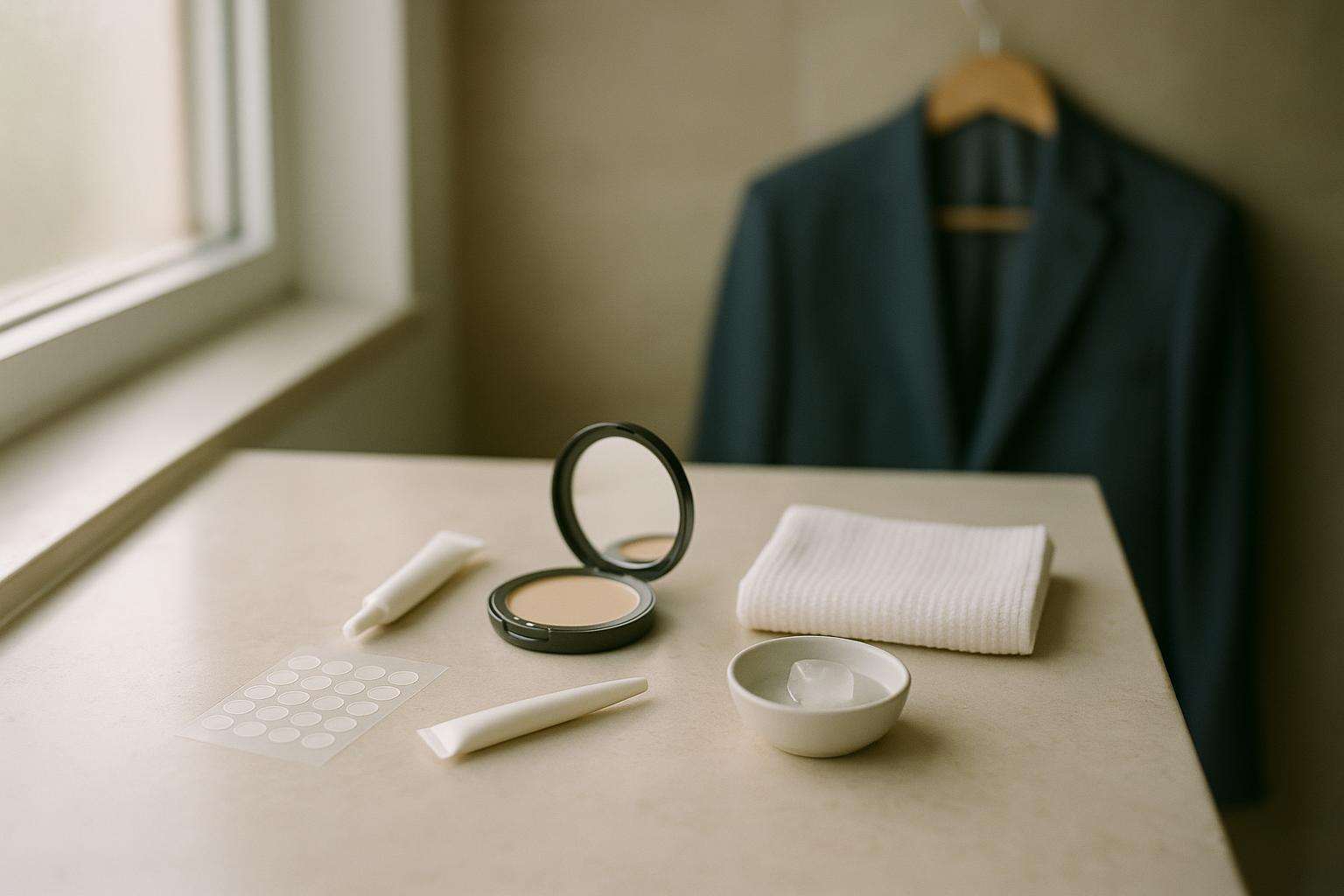
Change nothing new, never pop it, spot-treat narrowly, and — for a true cyst — let a dermatologist's cortisone shot do the heavy lifting. A blemish is a five-minute fix on the morning of; a scab from picking is not.
A spot has appeared, the wedding is days away, and the instinct is to attack it — a new mask, a stronger scrub, a hard squeeze in front of the mirror. Resist all of it. The men who arrive at the aisle with calm, even skin are almost never the ones who improvised in the final week; they are the ones who did a few small, correct things and left the rest alone. If you are the one steadying him through it, this is the plan to hand over — measured, dermatologist-backed, and built for the days you actually have left.
What should a groom do the week he breaks out before the wedding?
Triage in order. First, do not pop it — squeezing pushes inflammation deeper, slows healing, and trades a flat red mark you can conceal for a scab you cannot. Second, identify what you are dealing with. A deep, painful, dome-like lump under the skin is likely cystic and belongs to a dermatologist. A raised whitehead or ordinary surface pimple responds well to home care.
For a surface spot, the home kit is small and specific: a targeted spot treatment applied to the blemish only, a hydrocolloid patch, and a little ice. Nebraska Medicine notes that benzoyl peroxide works best on inflamed, pus-filled pimples because it is an antiseptic that kills the acne bacteria, while salicylic acid suits clogged pores and whiteheads. A hydrocolloid patch worn overnight then absorbs the fluid, flattens the bump, and keeps his hands off it.
| What he has | Best move | Timeline |
|---|---|---|
| Surface whitehead / small pimple | Spot treatment (salicylic acid or benzoyl peroxide) + hydrocolloid patch overnight + ice | 1–2 days |
| Inflamed red bump, no head | Benzoyl peroxide spot treatment + ice; patch once it heads up | 2–3 days |
| Deep, painful cyst | Dermatologist cortisone injection (do not treat at home) | 24–48 hrs after the shot |
| Spot on the day itself | Ice, then conceal with a brush and set with powder | Minutes |
What should a groom NOT try in the days before the wedding?
This is where most damage is self-inflicted, so be firm with him here. Nothing new. Dermatologist Dr. Dhaval Bhanusali, quoted in The Zoe Report, warns that introducing any new product or treatment in the month before a wedding risks "adverse reactions and scarring" — and the final week is the riskiest moment of all. That rules out debuting an unfamiliar serum, a clay mask he saw online, or a different cleanser.
It also rules out every aggressive procedure: no chemical peels, no lasers, no microneedling, no sudden retinoid ramp-up. The downside — redness and peeling with no time to recover — is simply too large. And no over-drying: stacking benzoyl peroxide, salicylic acid and an alcohol toner all at once can leave a flaking patch that photographs worse than the original spot. One targeted treatment, used as directed, is the whole job. Above all, no do-it-yourself extraction with a needle or fingernails. If it needs opening, a dermatologist does it sterilely.
When does a groom need to see a dermatologist?
Call within twenty-four to seventy-two hours if it is a painful deep cyst, if several large lesions arrive together, or if the spot sits somewhere photo-central — the nose, a mid-cheek, the chin. The professional answer is the cortisone (corticosteroid) injection, which The Zoe Report describes as the red-carpet standard: it reduces inflammation and can flatten an angry bump within 24 to 48 hours, sometimes faster. The earlier in the week he books, the more runway the shot has to work. A reputable dermatologist will walk through the rare side effects — occasionally a small temporary dimple at the injection site — beforehand. A derm can also perform a clean extraction or prescribe a short anti-inflammatory or antibiotic course when warranted.
How does a groom conceal a blemish for the photos?
For the morning of, a little makeup is entirely normal and partners routinely report that ten minutes with the artist already on site transforms the photographs. The sequence, drawn from War Paint for Men and The Knot, is simple: cleanse and moisturize, then a thin mattifying primer. A green-tinted color corrector neutralizes deep redness. Then conceal with a brush rather than fingers — a pea-sized amount, built in thin layers and matched precisely to his skin tone, so it disappears rather than sitting as a pale dot. Finish with a light dusting of translucent or pressed powder so the work survives heat, sweat, and a long outdoor ceremony.
Two backstops make the difference. Wear a hydrocolloid patch overnight and even during getting-ready, if it is discreet, to give the cleanest possible base before concealing. And brief the photographer early: most can quietly retouch a flat mark in post if anything shows. Between a calm overnight patch, a careful conceal and a photographer in the loop, a single spot is a non-event in the album.
Why do grooms break out the week of the wedding, and can it be prevented?
It is stress, plainly. The run-up to a wedding raises cortisol, which, as The Zoe Report explains, increases oil production in the follicles and can set off a flare — which is exactly why it tends to strike at the worst possible moment. It is extraordinarily common and reflects nothing he did wrong. The levers that genuinely help in the final week are unglamorous: protect seven to eight hours of sleep so the skin can repair, ease back on high-glycemic foods and dairy if he is prone to flares, drink water, and keep his existing routine reassuringly consistent. The goal of the last seven days is not transformation. It is steadiness — and a small, correct toolkit ready for the spot that may never come.
Frequently asked
Should you ever pop a pimple before the wedding?
No. It is the single most tempting and most damaging move. Squeezing pushes inflammation deeper into the skin, lengthens healing, and risks turning a flat red mark — which conceals beautifully — into a scab or scar, which does not. Dermatologists are unanimous on this. If the spot has genuinely come to a head, a hydrocolloid patch will draw out the fluid overnight far more gently than your fingers ever could, and it has the happy side effect of physically stopping you from picking while you sleep.
What is the fastest way for a groom to shrink a big pimple before the wedding?
For a large, deep, painful cyst, the fastest professional fix is a cortisone (corticosteroid) injection from a dermatologist. According to The Zoe Report, it is the red-carpet standard and can flatten an angry bump within 24 to 48 hours. Book it as early in the week as you can so there is runway. For a smaller surface spot, a targeted benzoyl peroxide treatment plus a hydrocolloid patch and a few minutes of ice will calm redness and swelling at home.
Benzoyl peroxide or salicylic acid — which spot treatment should he use?
It depends on the spot. Per Nebraska Medicine, benzoyl peroxide is an antiseptic that works best on inflamed, pus-filled pimples because it kills the acne bacteria. Salicylic acid, a BHA, is better for clogged pores, whiteheads and blackheads because it exfoliates and unclogs. Apply either to the spot only, not the whole face, and follow with moisturizer, since both can be drying. Do not stack them this close to the day.
Is it safe to get a facial or peel the week of the wedding?
No — not a peel, a laser, microneedling, or any new procedure. Dermatologist Dr. Dhaval Bhanusali, quoted in The Zoe Report, warns that introducing anything new in the month before a wedding risks adverse reactions and scarring. The week of is the worst possible time to debut a treatment. Keep the routine boringly consistent. A gentle, familiar facial done weeks earlier is fine; nothing aggressive or unfamiliar belongs in the final stretch.
Can a groom wear concealer for the wedding photos?
Absolutely, and many do. A small amount of color-matched concealer applied with a brush — not fingers, so the spot is not disturbed — covers redness without looking made up. War Paint for Men recommends building thin layers and setting with pressed powder so it survives heat, sweat and an outdoor ceremony. A green-tinted corrector underneath neutralizes deep redness. Ten minutes with the makeup artist already on site for the wedding party is usually all it takes.
Why do grooms break out right before the wedding?
Stress. The run-up to a wedding raises cortisol, and as The Zoe Report explains, that hormone increases oil production in the follicles and can trigger a flare. It is enormously common and not a sign anyone did anything wrong. The practical levers in the final week are protecting sleep, easing back on high-glycemic foods and dairy if he is prone, staying hydrated, and — above all — not panicking and overhauling his skincare overnight.