Grooming
Cologne Etiquette: How Much the Groom Should Wear (and When to Apply)
Scent is the one part of his look that travels. Here is how he wears it well: a few sprays, the right warm spots, and the right hour, so he reads as himself up close and never as a cloud across the room.
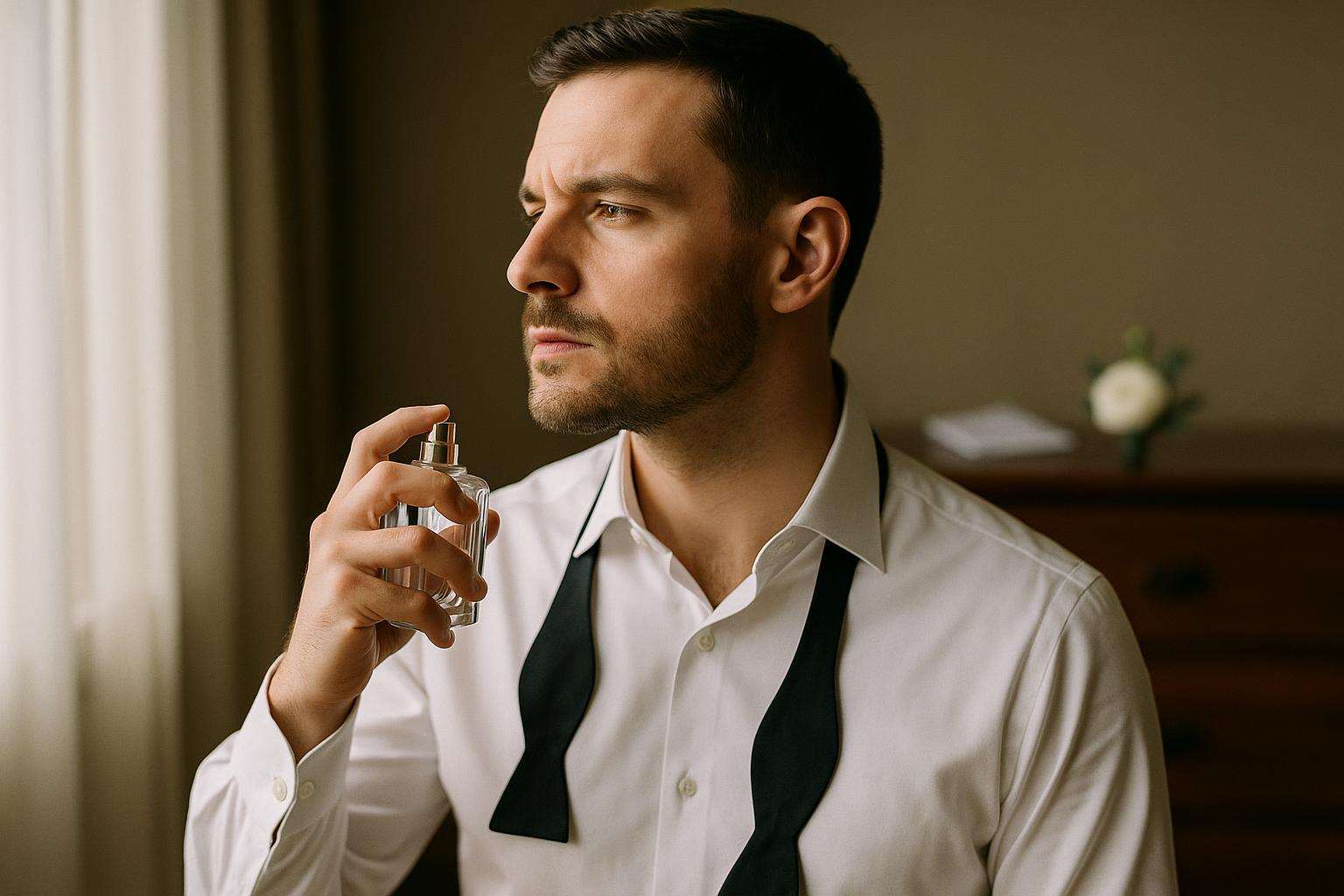
His suit can be flawless, his haircut fresh, the boutonniere pinned just so — and still, the thing people remember when he leans in for a hug is how he smells. Scent is the one part of his look that travels. It reaches the officiant standing a foot away, the photographer working inches from his jaw, and every guest in a receiving-line embrace. Worn well, it is a quiet signature. Worn heavily, it becomes the thing that competes with your bouquet and lingers in the photos. The good news: getting it right is less about which bottle he owns and more about restraint — a few sprays, the right warm spots, and the right hour.
The short answer: on the wedding day he should aim for two to four sprays of an eau de parfum, applied to clean, slightly damp pulse points about 20 to 30 minutes before leaving — close enough that someone notices only within a hug's distance, never from across the room.
How much cologne should the groom wear on the wedding day?
Less than he thinks. Everyday wear is two to three sprays; a special occasion can carry up to four or five spread across different zones, but that ceiling assumes a light fragrance and a cool, uncrowded setting — neither of which describes a wedding. Strong scents should be capped at two to three sprays.[1] A wedding amplifies everything: warm skin under a jacket, dancing, and dozens of close embraces all push the scent outward. A helpful gauge from the fragrance world is that two sprays of an eau de parfum throw a sillage — a scent trail — of about one to three feet, roughly arm's reach; four sprays double that radius, and eight or more stops being a fragrance and becomes an imposition.[2] For a groom who will be hugged all day, two to four sprays total is the gracious target. The etiquette test is simple and worth repeating to him: if someone can smell him from across the room, he has worn too much.[1]
Where should the groom apply cologne — and where not to?
Fragrance lifts best from warm spots where blood vessels sit close to the skin, the so-called pulse points. The reliable ones are the sides of the neck and throat, the wrists, and just behind the ears, with the chest and the inner elbows as secondary spots that hold a little longer under clothing.[3] Body heat there gently diffuses the scent through the day. Two cautions matter. First, he should not rub his wrists together after spraying — the friction crushes the delicate top notes and dulls the opening of the fragrance.[1] Second, he should spray onto skin, never the suit: alcohol can mark a silk lining, a tie or a pocket square, and a fragrance cannot evolve properly sitting on fabric.[4] Holding the bottle about six to eight inches away gives an even veil rather than one concentrated, wet patch.[2]
| Concentration | Suggested sprays | Best for the day if… |
|---|---|---|
| Eau de Toilette (EDT) | 3–4, lighter throw | a warm-weather or outdoor daytime wedding |
| Eau de Parfum (EDP) | 2, longest practical value | most weddings — an 8–12 hour day |
| Parfum / Extrait | 1, very concentrated | an evening or formal black-tie reception |
For an eight-to-twelve-hour wedding day, an eau de parfum is usually the right call: two sprays of a quality EDP last roughly six to ten hours on prepared skin, which spares him a mid-day reapplication.[2]
When should the groom put cologne on relative to the ceremony?
Timing is where most grooms go wrong, and it is the easiest fix. The scent should go on right after the shower, onto clean, slightly damp skin — open pores hold fragrance better — and before he dresses, so it settles into the skin instead of riding on top of his clothes.[1] Practically, that means about 20 to 30 minutes before leaving for the venue, which lets the sharp alcohol opening burn off and the truer heart of the scent emerge.[4] If he uses an unscented moisturizer or a body wash from the same fragrance line first, it gives the cologne something to bind to and stretches its life.[4] One non-negotiable: he should test the fragrance two or three full days in advance, never debuting an untried bottle on the day, because body chemistry and longevity have to be confirmed before they matter in front of two hundred people.[1]
How does he keep it from overpowering the bouquet and the first dance?
This is the part that makes it a wedding question rather than a grooming one. The bride holds a bouquet whose florals sit right at nose height during the ceremony and every formal portrait; a heavy cologne fights it and muddies both. The photographer works close to his face; the officiant and bride stand near him for the entire ceremony; the first dance is, by design, an embrace. Each of those is a close-quarters moment, which is exactly why the count stays low. The kind move is to coordinate the scent profile with the bride's perfume — complement it rather than match it, so a floral on her side meets a fresh or soft-woody note on his, never a clash.[4] If he wants a touch-up before the reception, he should carry a small travel atomizer and add a single spray to one pulse point — and only after confirming the original has genuinely faded, since olfactory fatigue makes a wearer underestimate what everyone else can still smell.[2] For a deeper primer on application mechanics, FragranceX's rules for applying cologne is a sound, practical reference. Done this way, his scent does what it should at a wedding: it reads as him, up close, in the moments that matter, and never announces itself from the back of the room.
Frequently asked
How many sprays of cologne should the groom wear on the wedding day?
Aim for two to four sprays total, and lean toward the lower end if the fragrance is strong or the venue is warm and crowded. Everyday wear is two to three sprays; a special occasion tolerates four to five only when the scent is light and the room is cool — neither typical of a wedding, where embraces, dancing and body heat under a jacket all push the scent outward.[1] A reliable etiquette test: if a guest can smell him from across the room, he has worn too much. The fragrance should register only within a hug's distance, where it does its best work.[2]
Where exactly should he apply cologne?
On warm pulse points where blood vessels sit close to the skin: the sides of the neck and throat, the wrists, and behind the ears, with the chest and inner elbows as longer-holding secondary spots under clothing.[3] Body heat there lifts and diffuses the scent through the day. He should spray from about six to eight inches away for an even veil rather than a wet patch, and — importantly — should not rub his wrists together afterward, because the friction crushes the delicate top notes.[1] Spray on skin, never on the suit, where alcohol can mark silk and the fragrance cannot evolve properly.[4]
When should the groom put his cologne on?
About 20 to 30 minutes before leaving for the venue, applied right after a shower onto clean, slightly damp skin and before he dresses.[1] Damp skin and open pores hold fragrance better, and applying before clothes lets the scent settle into the skin rather than sitting on fabric. The buffer also lets the sharp alcohol opening burn off so the truer heart of the fragrance is what greets guests.[4] Using an unscented moisturizer first gives the cologne something to bind to and extends how long it lasts through a long wedding day.
What is sillage, and why does it matter at a wedding?
Sillage is the scent trail he leaves behind as he moves through a room — distinct from projection, which is how far the scent radiates while he stands still.[2] At a wedding both are amplified by warmth, crowding and dancing, so a count that smells modest in a cool bathroom can read as heavy on the dance floor. Roughly, two sprays of an eau de parfum throw a sillage of one to three feet; four sprays double that radius. Keeping the count low keeps his sillage at a conversational distance — present in an embrace, invisible across the room.[1]
Should the groom's cologne match the bride's perfume?
It should complement, not match. They will stand close through the ceremony and the first dance, so the two scents share the air — but identical fragrances can feel flat or compete oddly. A better approach is to coordinate the overall profile: if she wears a floral, a fresh or soft-woody scent on his side pairs gracefully without clashing.[4] Just as important, his cologne should not overpower her bouquet, whose florals sit at nose height through every portrait. A light hand on his part lets both her flowers and her perfume keep their place in the day.
Can the groom reapply cologne during the reception?
Yes, but sparingly. He should carry a small travel atomizer and add a single spray to one pulse point — usually a wrist — rather than redoing the full application.[1] First, though, he should confirm the original has genuinely faded. A wearer's nose adjusts to its own scent through the day, a phenomenon called olfactory fatigue, which makes him underestimate what everyone else can still smell.[2] If a quality eau de parfum was applied properly to damp skin in the morning, it often lasts six to ten hours, so a touch-up may not be needed at all before the night winds down.