The Groom's Role
Groom Speech Examples and Tasteful Jokes That Always Land
Example groom-speech passages and clean one-liners, organized by moment — the opener, thanking the parents and in-laws, the tribute to you, and the closing toast — curated for warmth and class.
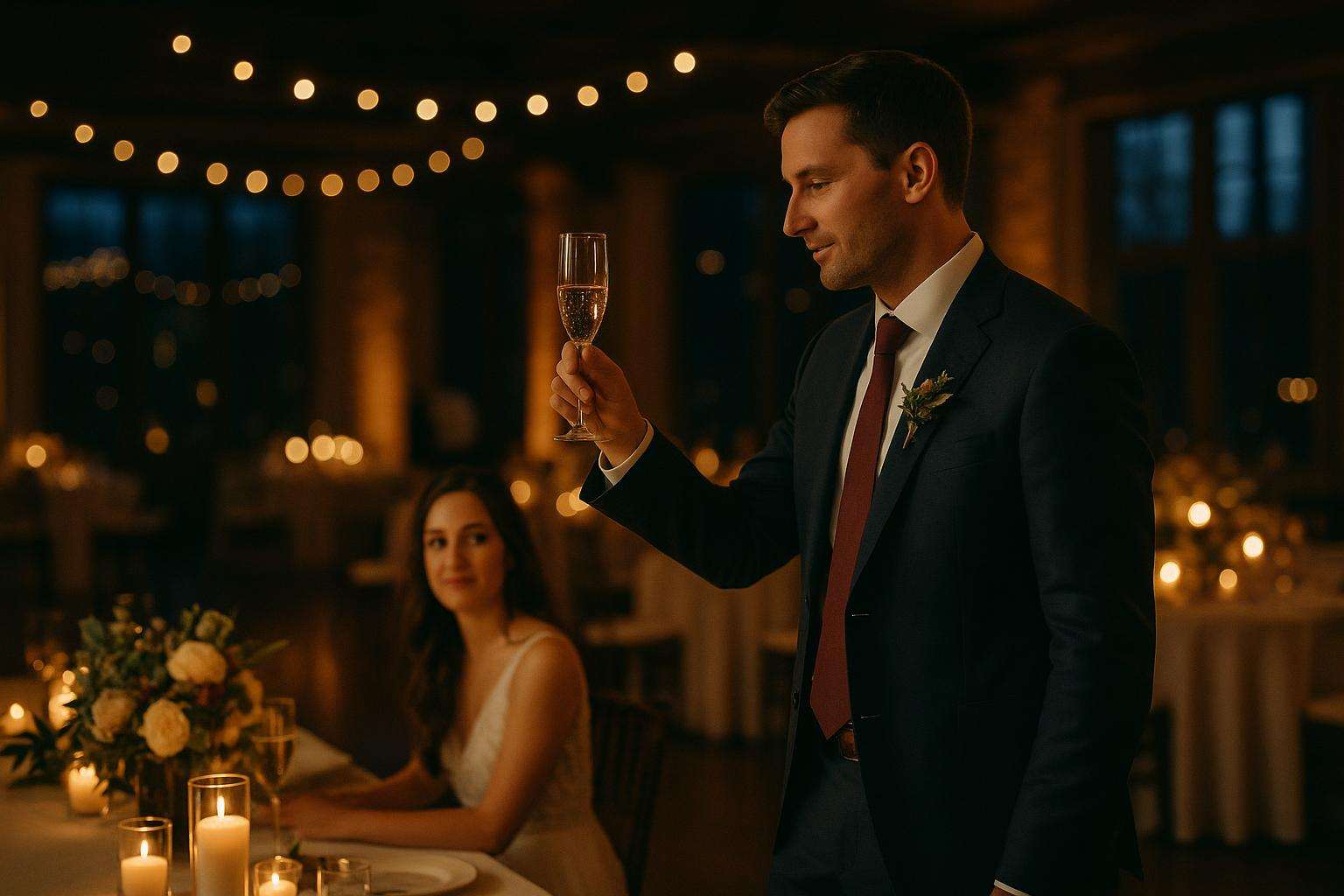
groom speech examplesgroom speech structuretasteful groom jokesthanking in-lawstoast to the bride
The quick verdict
Example groom-speech passages and clean one-liners, organized by moment — opener, thanking both families, the tribute, and the toast — curated for warmth and class.
- Best overall
- The Tribute to the Partner — The heart of the speech and the moment guests remember. Specific, observed praise delivered while turning to face her outweighs every joke and every polished paragraph — make this thirty percent of the whole.
- Best value
- The Self-Deprecating Opener — The lowest-risk, highest-return passage: one clean line about his own nerves or brevity settles the room and earns the first laugh without putting anyone — least of all the bride — in the joke.
- Best for Grooms who are nervous about public speaking
- The Shared Newlywed Toast — Splitting the speech into a couple's toast halves the spotlight and the word count, lets the partners trade lines, and turns the moment into a shared act rather than a solo performance.
How we evaluated
These passage types are not products; they are the building blocks of a real groom's speech, organized by the moment they belong to. Each was assessed against the published guidance of the major wedding authorities — The Knot, Bridebook, and seasoned wedding toastmasters — for three things: structural correctness (does it sit in the right place and run the right length), emotional payoff (does it move the room or merely fill time), and class (does it flatter rather than embarrass). The example lines are written to be copied for shape and refilled with the groom's own specifics; verbatim memorization is discouraged. No passage that relies on a laugh at someone else's expense was included.
- Structural fit and timing. Does the passage sit in the correct place in the canonical order, and does it respect the 3–5 minute / 400–600 word budget? Passages that keep the thank-yous tight and protect the tribute's share of the speech score higher.
- Specificity and emotional payoff. Generic praise that any groom could say about any partner scores low; concrete, observed detail and addressing the partner directly score high. The memorable moment is built on specifics, not adjectives.
- Class and inclusivity. Humor must be self-aware and inclusive. Anything risqué, any ex-partner or drinking story, any inside joke that excludes the room, and anything that embarrasses the partner is disqualifying.
Rating scale: 1–5 in 0.5 increments. 5.0 = essential to a strong speech and almost impossible to overdo when done with care. 4.0–4.5 = high-value with a clear execution caveat. 3.0–3.5 = useful in the right context or for the right groom. Below 3.0 = optional flourish that adds little.
Last verified .
At a glance
| # | Name | Rating | Best for | Pricing |
|---|---|---|---|---|
| 1 | The Self-Deprecating Opener | 5.0 | Every groom; especially valuable for those who want one dependable laugh up front before settling into sincerity | Free to use |
| 2 | Thanking the Parents and In-Laws | 4.5 | Every groom, and especially the groom keen to start his marriage on the right footing with his new in-laws | Free to use |
| 3 | The Tribute to the Partner | 5.0 | Every groom — this is the non-negotiable core, and the part most worth drafting first and rehearsing most | Free to use |
| 4 | The Wedding Party and Absent Loved Ones | 4.0 | Grooms with a close wedding party or family members they want to honor, who can keep both notes proportionate | Free to use |
| 5 | The Closing Toast | 4.5 | Every groom — the close is brief, low-effort, and high-impact when kept simple and sincere | Free to use |
| 6 | The Shared Newlywed Toast | 4.0 | Grooms anxious about public speaking, and couples who would rather share the moment than spotlight one person | Free to use |
The Self-Deprecating Opener
One clean line about his own nerves or brevity — the safest laugh in the room and the way to settle it.
Editor's pick
The opener has one job: settle a chattering, well-fed room and earn a little goodwill before the sincere part begins. The lowest-risk way to do that is a line at his own expense, never anyone else's. Two reliable shapes work for almost any groom. The first leans on nerves: "I've been told a good speech should be like a good marriage — heartfelt, honest, and not nearly as long as the best man is hoping." The second is the compliment disguised as a joke: "The two of them asked me to keep this speech like the groom's suit — stylish, classic, and mercifully short." Both get a laugh by promising brevity, which is exactly what guests want to hear. The mechanism matters: a self-aware opener makes the groom likeable and lowers the stakes for everything that follows, whereas a joke aimed at the wedding party or the in-laws can sour the room before the speech has earned any credit. He should land the line, wait for the laugh, and then shift cleanly into thanks. One opener is enough — stacking three jokes turns the welcome into a stand-up set and eats the time the tribute needs.
Strengths
- Self-aware humor is the safest possible laugh — no one in the room is the butt of the joke
- A 'keep it short' line manages the room's expectations and buys patience for the sincere passages
- Works for any groom regardless of comfort with public speaking; one rehearsed line is all it takes
Weaknesses
- Tempting to overdo — stacking multiple jokes turns the welcome into a comedy set and steals time from the tribute
- Best for
- Every groom; especially valuable for those who want one dependable laugh up front before settling into sincerity
- Pricing
- Free to use
Source: TopWeddingSites — Your Guide to Funny (& Tasteful) Groom Speech Jokes
Thanking the Parents and In-Laws
Two warm sentences each, balanced equally — the etiquette that earns real goodwill from both sides of the room.
After the welcome comes the round of thanks, and the etiquette here is balance: the groom should give his new in-laws roughly the same warmth and word count he gives his own parents. The reliable template, modeled on The Knot's own sample, thanks them for the person they raised and for the welcome they have shown — a single line that honors them and compliments his partner at the same time. A working example: "To Margaret and David — thank you for raising the person I get to spend the rest of my life with, and for making me feel like family from the very first dinner." Then he turns to his own parents with the same generosity: "And to my mom and dad — thank you for showing me, every single day, what a marriage worth having actually looks like." The discipline is brevity. The thank-you section is where speeches go to die, ballooning into a logistical inventory of who booked the band and who arranged the flowers. Warmth, not completeness, is the goal — about sixty seconds for all the thanks combined, then a clean pivot toward the partner. Guests consistently rate the speech as most memorable when it centers the partner rather than a long roll call, so the families are honored sincerely and the speech moves on.
Strengths
- Equal warmth to both families is the core etiquette and visibly earns goodwill from the in-laws
- Thanking them for the person they raised doubles as a compliment to the partner — efficient and gracious
- Keeping it to about sixty seconds protects the time the tribute needs
Weaknesses
- Easy to let it sprawl into a who-paid-for-what list; the logistical roll call deadens the room and runs long
- Best for
- Every groom, and especially the groom keen to start his marriage on the right footing with his new in-laws
- Pricing
- Free to use
Source: The Knot — Here's How to Master the Groom's Speech at a Wedding
The Tribute to the Partner
Specific, observed praise delivered while turning to face her — the heart of the speech and the moment guests remember.
Editor's pick
This is the speech. Everything before it is preparation; this passage is the reason a groom stands up at all, and it should occupy roughly thirty percent of the whole. The single technique that separates a memorable tribute from a forgettable one is specificity. "You are beautiful, kind, and the love of my life" is something any groom could say about any partner — it is true and it is hollow. The version people quote for years is concrete and observed: "You are the person who calls the restaurant to confirm the reservation because you know I'll forget. You are the one who noticed my grandmother was tired and quietly found her a chair before anyone else saw. That is who I get to marry." The second technique is physical: at this point the groom should stop talking about his partner to the room and turn to talk to her directly. The image of a groom looking at the person he loves and saying something he plainly means is worth more than any joke or polished sentence. He can close the tribute by naming what she has changed in him, then segue into how he proposed or a single small story that shows rather than tells. The craft rule beneath all of it is the writer's oldest: show, don't tell. Give the room indisputable evidence of the love rather than the label for it.
Strengths
- Specific, observed detail is what makes the moment memorable and unmistakably theirs rather than generic
- Turning to address the partner directly creates the single most powerful image in the speech
- Carries the emotional payoff of the entire toast — done with care, it cannot really be overdone
Weaknesses
- Defaulting to adjectives ('beautiful, kind, amazing') instead of evidence makes even a heartfelt tribute land flat
- Best for
- Every groom — this is the non-negotiable core, and the part most worth drafting first and rehearsing most
- Pricing
- Free to use
Source: Bridebook — Groom Speech: Examples, Tips, Structure & How to Write One
The Wedding Party and Absent Loved Ones
Name the bridesmaids and groomsmen with a light touch, then a quiet toast to those who could not be there.
Two moments share this slot. First, the wedding party: tradition makes it the groom's job — not the best man's — to thank and toast the bridesmaids, so he should name them and praise them with a warm, light touch rather than leaving it to chance. A working shape: "To the bridesmaids — thank you for getting her down the aisle calm, radiant, and exactly on time, which I'm told was no small feat. And to my groomsmen, who I'd trust with anything except the ring, apparently, given how long the search took this morning." The humor here, if any, stays affectionate and brief. Second, and tonally opposite, is the quiet toast to absent loved ones — those who have passed or simply could not travel. This is handled with restraint and sincerity, never milked: "Before I go on, I want to raise a glass to the people who should be here and aren't — they are in this room in every way that matters." A short pause, a lifted glass, and the speech moves forward. The risk in this section is imbalance: too long on the wedding party and it competes with the tribute; too heavy on the absent-loved-ones note and the room's mood drops just before the speech is meant to lift toward the close. Keep both brief, sincere, and proportionate.
Strengths
- Honors the etiquette that the groom, not the best man, thanks and toasts the bridesmaids
- The quiet toast to absent loved ones adds genuine depth and is widely expected at weddings
- Affectionate, brief humor toward the groomsmen reads as warm rather than as a roast
Weaknesses
- Mood-sensitive — a too-long or too-heavy absent-loved-ones note can deflate the room right before the close
- Best for
- Grooms with a close wedding party or family members they want to honor, who can keep both notes proportionate
- Pricing
- Free to use
Source: The Knot — Toast From the Bride and Groom to Guests: Samples and Tips
The Closing Toast
Land the plane on the future, raise the glass, and stop — a simple, hopeful line beats a clever one here.
The close is short and its only job is to land the plane cleanly. The mistake grooms make is reaching for a clever final line when a simple, hopeful one always lands better. The structure that works: a single sentence about the future they are walking into together, an invitation for the room to rise, and the toast itself. A dependable example: "So if you'll all raise your glasses — to my wife, to the life we're starting tonight, and to never going to bed angry, except on the nights she's right and I'm too stubborn to admit it. To the two of us." The optional last clause is a light, self-aware beat that keeps the close from turning saccharine, but even without it the toast works on sincerity alone. He should name the partner one final time, raise the glass, hold the moment for the room to drink, and then sit down — resisting the urge to add a coda. A clean stop is part of the craft. One classic device worth knowing: closing on a brief, warm aphorism, such as the line often attributed to comedian Rita Rudner that marriage is finding the one person you want to annoy for the rest of your life — used sparingly, it earns a final laugh that softens straight into the toast.
Strengths
- A simple, hopeful close lands more reliably than a clever one and is hard to get wrong
- Naming the partner one last time and raising the glass gives the room a clear cue to participate
- An optional light final beat keeps the ending from tipping into sentimentality
Weaknesses
- Tempting to add a coda after the toast; the clean stop is part of the craft and a tacked-on line weakens it
- Best for
- Every groom — the close is brief, low-effort, and high-impact when kept simple and sincere
- Pricing
- Free to use
Source: Bridebook — Groom Speech: Examples, Tips, Structure & How to Write One
The Shared Newlywed Toast
Split the speech into a couple's toast — half the spotlight, half the word count, and a shared moment with the room.
Best value
A solo groom's speech is traditional but never required, and for a nervous groom the best alternative is a shared newlywed toast delivered together. Splitting the speech halves both the spotlight and the word count for each person, and it turns the moment into a visible act of partnership rather than a solo performance — which many couples find more authentic to who they are anyway. The structure is simple: the partners alternate, each taking a piece. One welcomes and thanks the guests for traveling; the other handles the families. One delivers a short, specific tribute to the other; the partner answers it; then they raise the glass together. A working shape for the handoff: "We wanted to thank you together, because nothing about today — or about us — happens one at a time anymore." The thing that makes it work is rehearsal: a couple's toast that has been practiced aloud a few times feels like a duet, while an unrehearsed one stumbles over who-says-what. It also lets a confident speaker carry the structural parts while the nervous partner takes only the lines they feel sure of. The trade-off is coordination — two people, one running order, no improvising mid-speech — but for the groom who dreads standing alone, it is the most graceful way to still say something real.
Strengths
- Halves the spotlight and word count for a nervous groom while still delivering a heartfelt moment
- Reads as a genuine act of partnership and is increasingly common and well-received at modern weddings
- Lets a confident partner carry the structure while the nervous one speaks only their sure lines
Weaknesses
- Requires real coordination and rehearsal — an unpracticed couple's toast stumbles over who says what
- Best for
- Grooms anxious about public speaking, and couples who would rather share the moment than spotlight one person
- Pricing
- Free to use
Source: The Knot — Here's How to Master the Groom's Speech at a Wedding
Frequently asked
How long should a groom's speech be?
Three to five minutes, which works out to roughly 400 to 600 words at a natural speaking pace. That window is long enough to thank both families and say something genuine about his partner, but short enough to keep a fed, celebratory room engaged. The most common failure is not brevity — it is a thank-you list that swells into a roll call and pushes the speech past seven minutes, where the room quietly disengages and dinner runs late. A useful discipline is to cap all the thank-yous at about sixty seconds combined, then move firmly to the tribute, which is the part everyone is actually waiting for. According to The Knot, starting at least a month out and rehearsing aloud is what makes that timing feel natural rather than rushed.
What should a groom say to thank the in-laws?
Keep it brief, warm, and balanced — give the in-laws roughly the same word count as his own parents, which is the etiquette that earns real goodwill. The most reliable move is to thank them for the person they raised and for the welcome they have shown him, a single line that honors them and compliments his partner at once: something like "thank you for raising the person I get to spend my life with, and for making me feel like family from the first dinner." One or two sentences is plenty. The thing to avoid is letting the family thanks sprawl into a logistical inventory of who arranged what; warmth, not completeness, is the goal, and a sincere short line lands far better than a long one.
Are jokes appropriate in a groom's speech?
Yes, but humor is optional rather than required, and the safest laugh is one the groom takes at his own expense. A clean opener about his nerves or his promise to keep it short flatters the room without making anyone smaller. The hard exclusions are consistent across every reputable guide: no risqué material, no drinking or ex-partner stories, no inside jokes that shut out most of the guests, and nothing that mocks marriage or embarrasses his partner. A simple test settles most cases — if a joke gets its laugh by making someone in the room smaller, it is the best man's territory and the wrong instinct for the groom. A line that makes everyone feel a little warmer is always the better trade, and a speech needs only one or two of them.
What makes a groom's tribute to his partner memorable?
Specificity, and the courage to turn and address her directly. Generic praise — "beautiful, kind, the love of my life" — is true but hollow, because any groom could say it about any partner. The version people quote for years is concrete and observed: a real detail, like "you're the one who calls the restaurant to confirm the reservation because you know I'll forget." The second technique is physical: at the heart of the speech, the groom should stop talking about his partner to the room and turn to speak to her. As Bridebook and seasoned toastmasters both stress, the image of a groom looking at the person he loves and saying something he plainly means outweighs any joke or polished sentence. The writer's rule beneath it all is: show, don't tell.
In what order should a groom cover everything in his speech?
The settled order is: welcome the guests; thank those who helped and traveled (not only the people who paid); optionally raise a quiet toast to absent loved ones; acknowledge the wedding party, since it is the groom's job and not the best man's to thank the bridesmaids; then the tribute to his partner, which is the conclusion and should be about thirty percent of the whole; and finally the closing toast to the future. Holding that sequence keeps the speech from wandering and ensures it builds toward the right ending — the partner and the toast — rather than petering out on logistics. He should draft the tribute first since it carries the most weight, then build the lighter scaffolding of welcome and thanks around it.
What should a groom avoid saying in his wedding speech?
Avoid anything that gets a laugh or a reaction at someone else's cost. The reliable exclusion list, repeated across wedding authorities, covers risqué or crude material, stories involving drinking or other substances, any reference to ex-partners, inside jokes that leave most of the room out, and anything that mocks marriage or embarrasses his partner. Beyond jokes, avoid the marathon thank-you roll call and reading the whole thing off a phone, which reads as disengaged and photographs poorly. The deeper principle, per Lin Pernille's speechwriting guidance, is that guests remember how a speech made them feel, not whether it was flawless — so anything that makes the room or the couple feel smaller is the wrong choice, no matter how funny it seemed in the draft.