Wedding Bands
Comfort-Fit vs. Standard-Fit Men's Wedding Bands (and How to Size)
What comfort-fit actually changes about his ring size, how to measure at the right time of day, the knuckle-versus-base problem, and how to order a band you cannot resize.
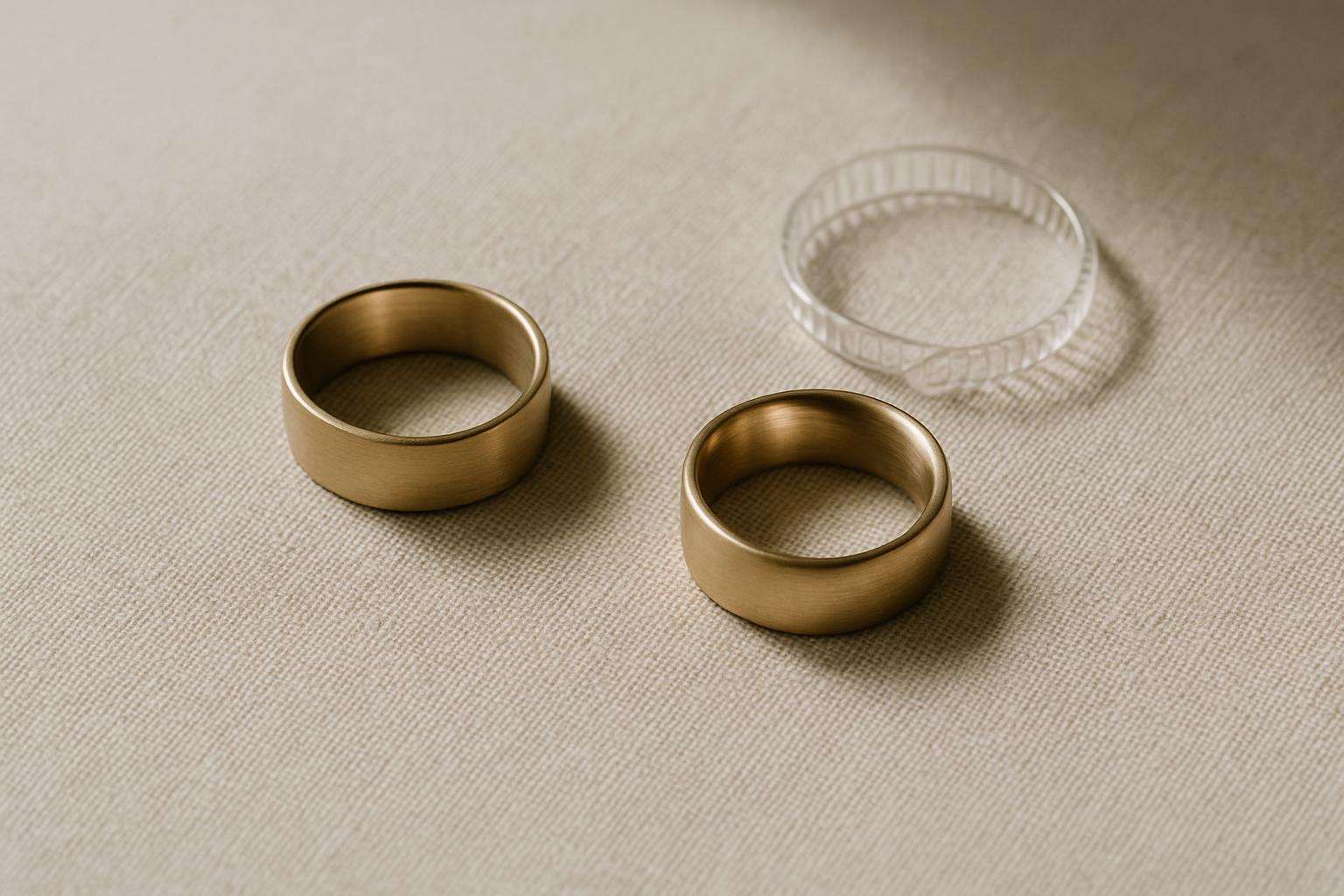
The difference between comfort-fit and standard-fit lives entirely on the inside of the ring. Standard fit is flat against the finger; comfort fit is domed and rides on a narrower band of contact, so it fits more loosely at the same labeled size. The working rule for most men's-width bands is to take his standard-fit size and order a half size smaller for comfort fit — then adjust for band width, measure at a normal late-day baseline rather than a cold morning, size between his knuckle and the base of his finger, and remember that many men's metals cannot be resized, so a free exchange policy matters.
If you are the one ordering his band — or quietly trying to get his size right before he does — the single most useful thing to understand is that "comfort fit" is not a size. It is the shape of the inside of the ring, and that shape changes which size he should order. Get the fit profile and the size right together and his ring will feel like nothing at all on his finger, which is exactly what a man who has never worn a ring wants. Get them out of step and even a beautiful band becomes the thing he keeps twisting at dinner.
What is the difference between comfort-fit and standard-fit?
Turn either ring over and look at the interior — the surface that touches his finger — and the whole distinction is visible.
A standard-fit band has a flat interior. The metal cuts straight across, the inside diameter is the same from edge to edge, and the ring sits flush against the full width of the finger. It is the traditional profile, common in platinum and white gold, and many men find it sits securely without spinning.
A comfort-fit band has a domed, slightly convex interior that curves away from the finger at the edges. The center of the band is a touch narrower than the edges, so the ring rides on a slim band of contact rather than the whole width. As Thorum explains, that dome means less metal touches the skin, so the ring creates less friction, slides over the knuckle more easily, and is far less likely to pinch or leave an indentation. It is why comfort fit is the default for most men's bands and the strong recommendation for anyone who has never worn a ring or who works with his hands. Manly Bands notes that most of its men's rings are made comfort fit for exactly this reason.
How does comfort fit change his ring size?
Here is the part that trips couples up. Because comfort fit touches less of the finger, it fits more loosely at the same labeled size — a size 10 comfort fit feels bigger than a size 10 standard fit. So you cannot simply carry his standard size over.
The jeweler's rule is straightforward: have him sized in a standard-fit ring first, then order the comfort-fit band a half size smaller. Both Manly Bands and Larson Jewelers give this same guidance. But band width modifies it, and men's bands are usually wide enough that width matters:
| Band width | Comfort-fit adjustment vs. standard size | Why |
|---|---|---|
| 5mm or under | Roughly true to size | The dome is too small to change the fit noticeably |
| 6mm – 7.5mm | About a half size smaller | The comfort-fit dome fits loosely at standard size |
| 8mm and wider | Close to standard size | The extra width tightens the fit and offsets the dome |
One honest tension is worth flagging, because you will run into it. The comfort-fit dome argues for sizing down, while wide bands in general feel snug, and some guidance — including Manly Bands' material-based sizing notes — suggests ordering a half size up for 6, 7, and 8mm bands. Both are right; they are simply describing opposite forces. Width pushes the fit tighter, the dome pushes it looser, and on a given ring those effects partly cancel. The lesson is not to distrust the rules but to treat them as a strong first guess and then confirm by feel.
When and how should he measure his finger?
A finger is not a fixed size. It swells and shrinks with temperature, hydration, salt, exercise, and the time of day, so when he measures matters as much as how.
- Time of day. Avoid both extremes — a cold morning finger reads too small, and a post-workout or hot-day finger reads too large. Blue Nile recommends a mid-to-late-day reading; Manly Bands suggests checking at two different times of day. Because a wedding band is worn through every condition, size to a realistic, slightly-larger late-day baseline so he can still get it off by evening.
- Use a real sizer. A plastic or metal ring sizer is far more accurate than paper or string, which bend and stretch. Blue Nile mails a free plastic sizer; Manly Bands sells a multi-size tool and offers a free printable.
- Wear-test the size. Have him wear the candidate size for a few hours of normal activity. If it slides off when he washes his hands, drop a half size; if the finger reddens, go up a half. There should be slight resistance coming off.
What if his knuckle is bigger than the base of his finger?
Many men have a prominent knuckle, which creates the classic sizing trap: size to the base and the ring will not pass the knuckle; size to the knuckle and it spins loose at the base. The answer jewelers give is to measure both spots and choose a size in between — large enough to clear the knuckle with slight resistance, snug enough that it does not spin where it sits. For a gold or platinum band, a jeweler can add sizing beads or a Euro shank to bridge a wide gap, but those fixes are not available on the hard men's metals, which is one more reason a comfort-fit profile — easier over the knuckle by design — is so often the practical choice for him.
Can a comfort-fit band be resized, and how do you order for swelling?
Frequently, no. Many men's comfort-fit bands are tungsten, titanium, cobalt, ceramic, or meteorite, and these materials generally cannot be resized with traditional tools; Blue Nile likewise excludes tungsten and alternative-metal bands from its resizing service. Gold and platinum comfort-fit bands can usually be sized within a range, though the dome complicates it. Because so many men's bands are effectively one-size-permanent, the sizing decision carries weight, and three habits protect you: order from a retailer with a free size-exchange window — Manly Bands offers one on eligible styles within 30 days; for a finger that swells with heat or work, size to the realistic larger end rather than the cold morning reading; and if he falls between sizes on a band that cannot be resized, the safer error is usually the size that still clears the knuckle. Sized this way, his ring becomes the easiest thing he wears all day — which, for the man standing next to you, is precisely the point. If you are also choosing her engagement or wedding band, the same interior-profile logic applies — see how comfort fit applies to her rings for a side-by-side look at both decisions.
Frequently asked
Do comfort-fit rings run larger or smaller than standard fit?
A comfort-fit ring fits more loosely than a standard-fit ring at the same labeled size, because its domed interior touches a narrower band of the finger instead of the full flat width. So in practice, the same size feels bigger in comfort fit. The standard advice is to determine his standard-fit size first and then order the comfort-fit band a half size smaller, as both Larson Jewelers and Manly Bands advise. The exception is very wide bands, where width tightens the fit enough to offset the dome.
What size comfort-fit band should he order if he knows his standard size?
As a starting rule, take his standard-fit size and go a half size down for a comfort-fit band — Manly Bands, which makes most of its men's rings in comfort fit, says to simply subtract a half size. Band width then adjusts that: under 8mm, keep the half-size reduction; at 8mm and wider, a comfort-fit band fits close to a standard size, so the reduction shrinks. Below about 5mm the comfort-fit effect is barely noticeable. The half-size rule is a strong first guess, not a guarantee — confirm it by wear-testing the actual width before buying.
When is the best time of day to measure his finger?
Aim for a normal late-day reading and avoid both extremes. Fingers shrink when cold and swell after exercise, heat, or salt, so a morning measurement can run too small and a post-workout one too large. Blue Nile recommends measuring mid-to-late day; Manly Bands suggests checking at two different times and not sizing right after a hard day's work. Because a wedding band is worn every day in every condition, sizing to a realistic, slightly-larger baseline beats sizing to his smallest morning finger and finding the ring won't come off by evening.
How should he size if his knuckle is bigger than the base of his finger?
This is one of the most common men's sizing problems. Measure at both points — the knuckle and the base — and choose a size in between, per Blue Nile. The ring should slide over the knuckle with slight resistance and sit snugly, not spinning, at the base. For a precious-metal band a jeweler can add sizing beads or a Euro shank to bridge a large gap, but those fixes are not available on most hard men's metals, so a comfort-fit profile — which clears the knuckle more easily — is often the simpler answer.
Can a comfort-fit men's wedding band be resized?
Often not. Many men's comfort-fit bands are made from tungsten, titanium, cobalt, ceramic, or meteorite, and these hard or exotic materials generally cannot be resized with traditional jeweler's tools; Blue Nile excludes tungsten and alternative-metal bands from its resizing service. Gold and platinum comfort-fit bands can usually be sized within a range. Because so many men's bands are effectively one-size-permanent, order from a retailer with a free size-exchange window — Manly Bands offers a free exchange on eligible styles within 30 days — and confirm the policy before you buy.
Does band width really change which size to order?
Yes — width is the second lever after fit profile. A wider band covers more of the finger and feels snugger, so a 6mm or 8mm band can feel tight in a size that a 4mm band wears comfortably. That is why some retailers suggest sizing up a quarter to a half size for wide bands, even as comfort fit pushes the other way. The two effects partly cancel out, which is exactly why a formula alone is risky: for any band 6mm or wider, wear-test the real width and fit before committing, especially on a metal that cannot be resized.