Wedding Bands
How Much to Spend on a Men's Wedding Band — and the Best Places to Buy
A clear-eyed budget and buying guide for his ring: realistic prices by metal, online versus the local jeweler, and the warranty and resize policies that quietly decide whether you spent wisely.
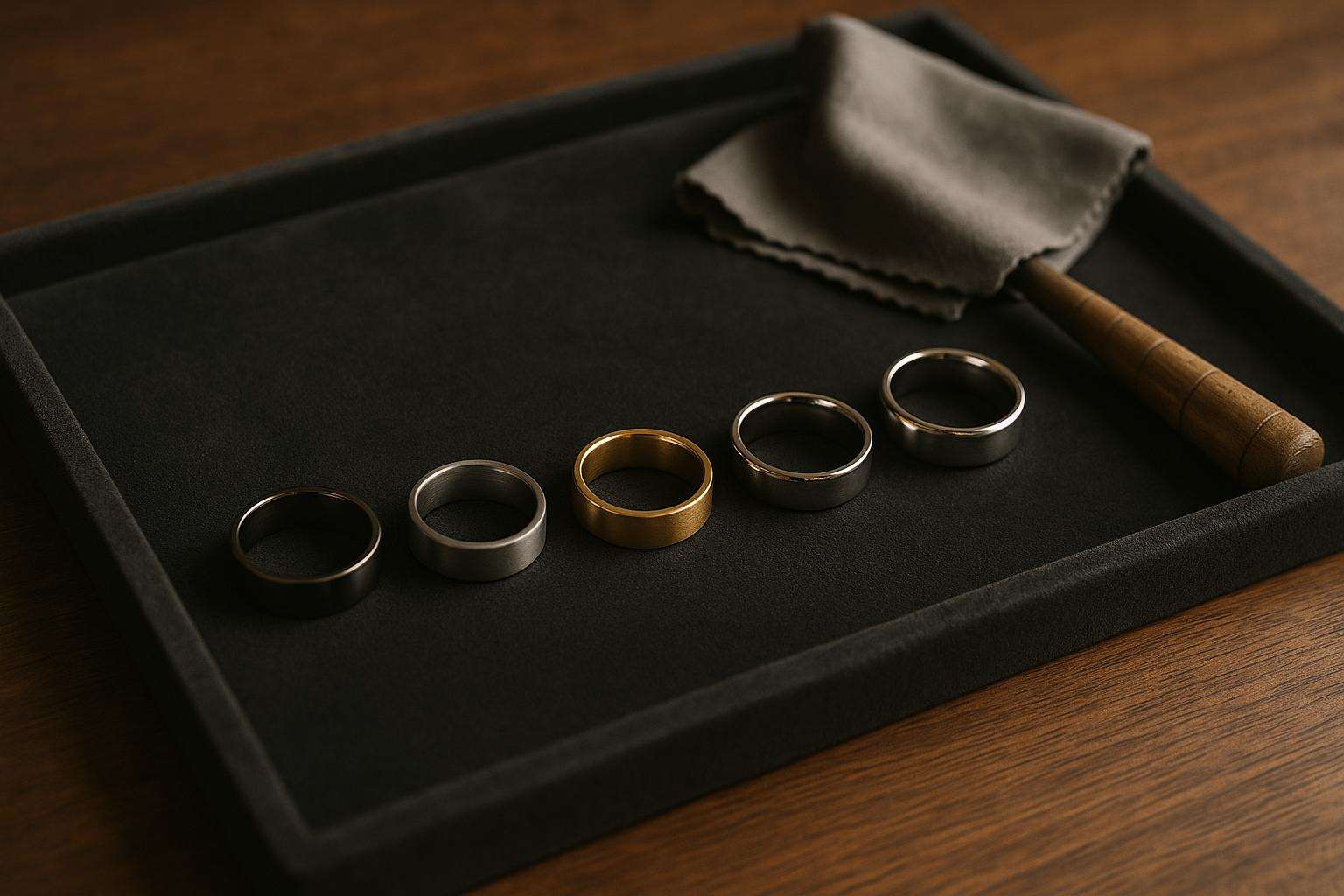
Most grooms spend $300 to $600 on a wedding band, and The Knot puts the average men's band at about $600. Metal is the biggest cost lever — tungsten and titanium run $100 to $500, 14K gold $500 to $1,500, platinum $1,500 and up. But the decision that protects your money is the resize and warranty policy, because the cheapest metals cannot be resized at all.
Of all the rings in a wedding, his is the quiet one. It carries no center stone and no negotiation, and it is easy to leave to the last minute. Yet it is the ring he will actually wear every single day for the rest of his life — through work, washing up, and forty winters — so it is worth choosing with the same care you gave everything else. The good news is that a men's band is one of the more rational purchases in the whole wedding. Here is what it should cost, where to buy it, and the one piece of fine print that matters more than the price.
What is the realistic price range for a men's wedding band?
According to The Knot's 2024 Jewelry & Engagement Study — which surveyed more than 7,000 recently engaged couples — the average men's wedding band costs about $600, while women's bands average around $1,200. That men's figure has risen gently from roughly $510 in 2019, nudged up by the price of gold and a growing taste for small diamond accents in men's bands. Across the market, men's bands span from about $100 to $5,000, but the great majority of grooms settle between $300 and $600.
The single largest factor in that number is metal. Choose the metal first and the price almost decides itself.
| Metal | Typical price | Why |
|---|---|---|
| Tungsten carbide | $100–$500 | Hardest common ring metal; about four times more scratch-resistant than titanium; cannot be resized. |
| Titanium | $100–$500 | Very light and hypoallergenic; ideal for sensitive skin and active hands; cannot be resized. |
| 14K gold | $500–$1,500 | The popular middle ground — durable, classic, the best balance of value and prestige. |
| 18K gold | $1,000–$2,500 | Higher purity and richer color; softer than 14K, so it shows wear a little sooner. |
| Platinum | $1,500–$3,000+ | Rarest and most durable precious metal; naturally white, hypoallergenic, never needs re-plating. |
As With Clarity notes in its cost guide, choosing 14K gold over platinum in a white metal can save hundreds of dollars for an almost identical look — a useful lever if the budget is tight elsewhere.
Should you buy a men's wedding band online or from a local jeweler?
This is where couples often hesitate, and the honest answer is that both can be right. Online specialists carry far less overhead, which is why James Allen and Blue Nile routinely price 25 to 40 percent below physical stores, and their 360-degree HD imaging and live gemologist video calls have closed most of the gap with seeing a ring in person. A local jeweler earns its premium on three things you cannot get online: an in-person finger measurement on a proper metal mandrel, same-day service, and a real relationship for future repairs.
The path many grooms take blends the two. Have him sized in person — sizing matters enormously, and a hot day or a cold morning can shift a reading by half a size — then decide whether to buy from that jeweler or order the exact style online. What you should never do is guess his size from a string and a ruler for a metal that cannot be corrected later.
How do warranty and resize policies change the real cost?
Here is the part most buying guides bury, and it is the most important sentence on this page: tungsten, titanium, ceramic, and cobalt cannot be resized. They are too hard to cut and re-solder. Fingers, meanwhile, change over a lifetime — weight, temperature, age, the simple swelling of a summer afternoon. So for any non-resizable metal, the band is only a safe purchase if the seller offers a lifetime size exchange, where they replace it in the correct size rather than alter the original.
Read each policy for what it actually covers. A “lifetime warranty” that covers only manufacturing defects is far narrower than one that covers repairs, re-polishing, and sizing. Treat the warranty as part of the price.
Which retailers are best for buying a men's wedding band?
| Retailer | Best for | Warranty & resize |
|---|---|---|
| Manly Bands | The widest style range and durable everyday metals (plus wood, meteorite, and licensed designs) | Free lifetime manufacturing warranty; one complimentary resize or exchange within 30 days; free silicone band and 30-day returns. |
| Blue Nile | Precious-metal bands with strong, established service | Limited lifetime warranty on defects; one free resize within a year (excludes alternative metals). |
| James Allen | Best online imaging; the most service-rich warranty | Lifetime warranty covering repairs and maintenance — free prong work, re-polishing, rhodium plating; now a Blue Nile collection. |
| Brilliant Earth | Ethically sourced recycled metals and traceable stones | Free lifetime warranty on defects; free resize within 60 days; paid plan extends coverage. |
| Larson Jewelers | Tungsten and titanium specialists (500+ styles, popular 8mm widths) | Lifetime warranty and lifetime size exchange even on tungsten; free shipping and engraving. |
Match the retailer to his metal and the policy he needs. A groom set on a brushed tungsten band is best served by a specialist with lifetime exchange; one who wants a classic platinum band may prefer the established service of Blue Nile or a trusted local jeweler.
So how much should you actually spend?
Decide by hand and habit, not by sticker price. If he works with his hands, a $300 tungsten or titanium band may genuinely outlast and out-serve a $2,000 platinum one. If he wants weight, heirloom value, and a ring that never needs re-plating, platinum justifies its premium. For most grooms, a 14K gold or premium titanium band between $300 and $700 is the sensible centre of the market: handsome, durable, and easy to live with. Spend a little less and put the difference toward an engraving inside the band — a date, an initial, a private word — which costs almost nothing and means everything. The right band is simply the one suited to his hand, his work, and the next fifty years.
Frequently asked
How much should a groom spend on a wedding band?
There is no rule, and you should ignore any that promise one. According to The Knot's most recent jewelry study, the average men's wedding band costs about $600, and most grooms land somewhere between $300 and $600. A handsome, hard-wearing titanium or tungsten band sits comfortably under $500, while a 14K gold band typically runs $500 to $1,500. Spend what feels right for a ring he will wear every day for decades, not what a salesperson or an old saying says he ought to.
Is it safe to buy a men's wedding band online?
Yes, and many couples save real money doing it. Online specialists such as James Allen and Blue Nile typically price 25 to 40 percent below brick-and-mortar stores, and they now offer 360-degree HD video and live video consultations that rival seeing a ring in person. The one thing you cannot do over a screen is size his finger accurately. Have a local jeweler measure him on a proper metal mandrel first, then order online with confidence — and confirm the seller's resize or exchange window before you check out.
Can a tungsten or titanium wedding band be resized?
No. Tungsten, titanium, ceramic, and cobalt are too hard to cut and re-solder, so they cannot be resized the way gold or platinum can. That is not a dealbreaker — but it makes the seller's policy essential. Reputable specialists offer a lifetime size exchange: if his finger changes over the years, they send a new band in the correct size. Larson Jewelers, for instance, includes lifetime sizing on tungsten. Always confirm an exchange program exists before choosing a non-resizable metal.
Which retailer is best for a men's wedding band?
It depends on what he values. For the widest range of styles and durable everyday metals, Manly Bands is the men's specialist. For precious-metal bands with strong service, Blue Nile and James Allen (now a Blue Nile collection) lead, with James Allen offering the most generous lifetime warranty covering repairs and maintenance. For ethically sourced recycled metal, Brilliant Earth is the choice. For tungsten and titanium with lifetime sizing, Larson Jewelers specializes. Match the retailer to his metal and the policy he needs.
What ongoing costs come after buying the ring?
A few, and they are worth planning for. Resizing a gold or platinum band later runs roughly $75 to $200. White-gold bands need periodic rhodium re-plating to stay bright — budget somewhere around $120 to $220 a year for cleaning, inspection, and plating. Platinum sidesteps that entirely because it is naturally white, though it costs more upfront. Tungsten and titanium have almost no upkeep but rely on the exchange policy rather than repair. Factor the metal's lifetime cost, not just its sticker price.
Does a more expensive metal mean a better wedding band?
Not for everyday wearability. Platinum and gold carry prestige, weight, and heirloom value, and platinum never needs re-plating — but tungsten is harder and more scratch-resistant than any precious metal, and titanium is the lightest and most comfortable for an active hand. A groom who works with his hands may genuinely be better served by a $300 tungsten band than a $2,000 platinum one. The best band is the one suited to his hand and his life, not the one with the highest price.