Wedding Bands
Men's Wedding Band Metals Compared: Gold, Platinum, Titanium, Tungsten & More
A clear, side-by-side guide to the metals his ring could be made from — what each one costs, how it wears, whether it can be resized, and which suits his hands.
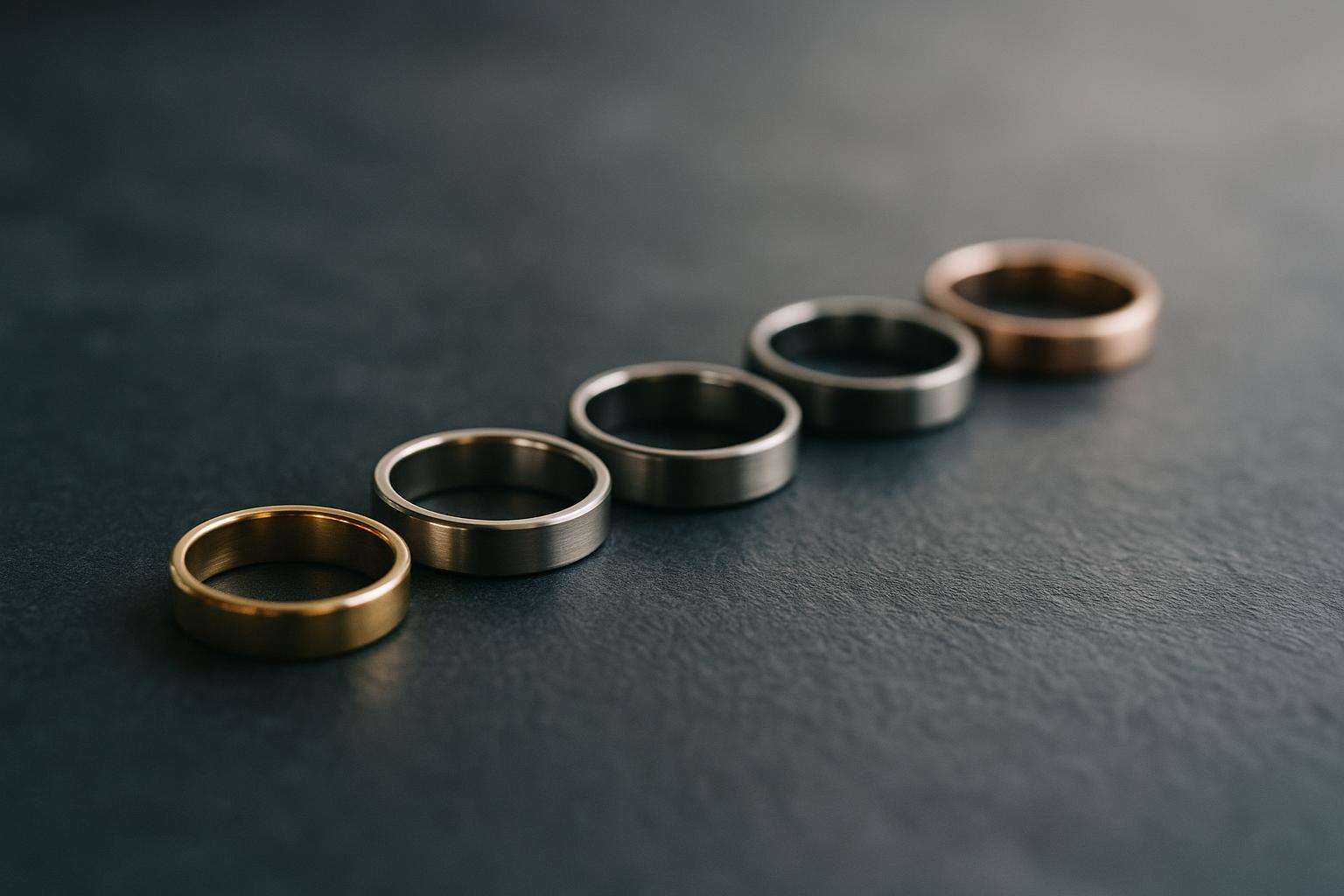
There is no single best metal for his wedding band — only the one that fits his hands and his life. Pick on four axes: how hard it is worn (tungsten and titanium win on scratch resistance), how heavy it should feel, whether his skin is sensitive (titanium, platinum and palladium are safest), and whether it may ever need resizing (only gold, platinum and palladium can). Get those four right and the metal chooses itself.
When you start shopping for his ring, the choice of metal is the first real decision — and the one most likely to overwhelm. A jeweler's case can hold a dozen options that look broadly similar at arm's length but behave completely differently over a marriage's worth of wear. The good news is that you do not need to weigh all twelve. Nearly every man's band comes down to six metals, and each answers a different question about how he lives. Here is how they compare.
What metals are used for men's wedding bands, and how do they differ?
The options split cleanly into two families. Precious metals — gold (in yellow, white and rose), platinum and palladium — are the traditional choices: resizable, repairable, and valued for the material itself. Contemporary metals — titanium, tungsten carbide and cobalt chrome — are harder, lighter on the wallet, and built for a hands-on life, but most cannot be resized once made.
| Metal | Typical price | Durability | Weight | Resizable | Skin-friendly |
|---|---|---|---|---|---|
| Yellow / rose gold | Mid (solid ~$500+) | Soft; patinas | Medium | Yes | Generally yes |
| White gold | Mid | Soft; needs replating | Medium | Yes | Caution (nickel/rhodium) |
| Platinum | Highest ($800+) | Good; never loses density | Heavy | Yes | Yes (hypoallergenic) |
| Palladium | High, below platinum | Good | Light | Yes | Yes (hypoallergenic) |
| Titanium | Low–mid ($150–$500) | High; corrosion-proof | Very light | No | Yes (biocompatible) |
| Tungsten carbide | Low–mid ($150–$500) | Highest; can crack | Heavy | No | Mostly |
| Cobalt chrome | Low–mid | High; polishable | Medium | No | Caution for some |
Those price bands follow the published tiers at men's-band specialist Manly Bands, where titanium, tungsten and cobalt cluster around $150 to $500, exotic and meteorite materials run $500 to $800, and solid gold and platinum start near $500 and climb from there.
Which men's wedding band metal is the most durable?
If the single thing that matters is a ring that stays looking new, the answer is tungsten carbide. It rates roughly a 9 on the Mohs hardness scale — diamond is a 10 — making it by some distance the most scratch-resistant material sold for wedding bands. The catch is the flip side of that hardness: tungsten is brittle, so where a softer metal would dent under a hard blow, tungsten can crack or shatter. It is the ideal ring for a man who fears scratches more than he fears the rare sharp impact.
Titanium is the durable all-rounder — aerospace-grade strength at a fraction of the weight, corrosion-resistant against salt water and chlorine, and far more forgiving of a knock than tungsten. Cobalt chrome rivals tungsten's scratch resistance with one valuable advantage: it can be polished to remove scratches, where tungsten cannot. Among the precious metals, platinum is the standout: it is harder than gold, and when it does scratch the metal is merely pushed aside rather than worn away, so a platinum band never thins over a lifetime. Gold is the softest of the common choices and will, over years, gather a fine patina of scratches that many men come to value as a record of a life well lived.
Which metals are hypoallergenic and safe for sensitive skin?
If his skin reacts to inexpensive jewelry, the metal is not a cosmetic decision — it is a comfort one. The three safest choices are titanium, which is biocompatible enough to be used for surgical implants; platinum, naturally white and pure enough to need no nickel alloy; and palladium, a member of the platinum group whose jewelry alloys contain no nickel, zinc or the usual sensitizing metals.
Two options warrant a second thought. White gold gets its color from alloys that often contain nickel, finished with a rhodium plating that wears thin over time — both of which can irritate reactive skin. And cobalt, despite many cobalt-chrome bands being sold as hypoallergenic, is itself a recognized skin sensitizer for a minority of wearers. If sensitivity is a known issue, steer toward titanium, platinum or palladium and you remove the question entirely.
How much do men's wedding bands cost, and can they be resized?
Two practical questions decide more marriages-worth of comfort than aesthetics ever will. On price, tungsten and titanium are the value leaders; cobalt chrome offers a near-platinum white look for roughly a third of platinum's cost; palladium delivers the bright platinum-group color while undercutting platinum because it is far less dense — nearly half the weight — and therefore lighter and less expensive. Platinum sits at the top for prestige and material value. There is no etiquette requiring his band to match an engagement ring's cost.
On resizing — the factor couples most often overlook — only gold, platinum and palladium can be resized and repaired by a jeweler. Titanium, tungsten and cobalt cannot; the very hardness that protects them defeats a jeweler's tools, so a change in finger size usually means a new ring. If his weight or activity level is likely to shift in the years ahead, that alone is a strong argument for a precious metal. Major retailers including Brilliant Earth and Blue Nile lay out the same trade-off in their men's metal guides.
So which one should he choose?
Match the metal to the man. For the tradesman, mechanic or anyone hard on his hands, choose tungsten for sheer scratch resistance or titanium if he wants that toughness in a featherweight he'll forget he's wearing. For sensitive skin, choose titanium, platinum or palladium. For a man who values tradition, lasting value and the freedom to resize, choose gold or platinum; for the platinum look at a gentler price and weight, choose palladium. Settle the four questions — wear, weight, skin and resizing — and you will not be choosing a metal so much as confirming the one his life already points to.
Frequently asked
What is the best metal for a men's wedding band?
There is no single best metal — only the one that fits how he lives. For a hands-on man who works with tools, a hard alternative metal like tungsten, titanium or cobalt will stay looking new for years. For a groom who wants tradition, lasting material value and the option to resize later, a precious metal — gold, platinum or palladium — is the wiser choice. If his skin is sensitive, titanium, platinum and palladium are the safest. Decide on his priorities first — durability, weight, skin, budget, resizing — and the metal almost chooses itself, as both Blue Nile and Brilliant Earth lay out in their men's guides.
Is tungsten or titanium better for a wedding ring?
They solve different problems. Tungsten carbide is the most scratch-resistant material sold for rings — roughly a 9 on the Mohs scale — so it shrugs off the daily abrasion that dulls softer metals; its weakness is that a hard enough impact can crack it rather than dent it. Titanium is dramatically lighter, aerospace-strong, fully hypoallergenic, and far more forgiving of a sharp knock. Choose tungsten if he wants maximum scratch resistance and a substantial weight; choose titanium if he wants a ring he barely feels and that won't shatter. Neither, importantly, can be resized.
Which men's wedding band metals are hypoallergenic?
The safest choices for reactive skin are titanium, which is biocompatible enough to be used in surgical implants; platinum, which is naturally white and needs no nickel alloy; and palladium, a platinum-group metal whose alloys contain no nickel, zinc or the usual sensitizers. The metals to be cautious with are white gold — its nickel-bearing alloys and rhodium plating can irritate skin as the plating wears — and, for a minority of wearers, cobalt, which is itself a known sensitizer despite many cobalt-chrome bands being marketed as hypoallergenic.
Can a men's wedding band be resized?
Only some can. Gold, platinum and palladium are fully resizable and repairable — any jeweler can take them up or down a size as his finger changes over the years. Titanium, tungsten and cobalt generally cannot be resized; their hardness is exactly what makes them resistant to a jeweler's tools, so if the fit changes the ring is usually replaced rather than altered. That makes accurate sizing essential up front for an alternative metal — and resizability itself a genuine reason to choose a precious metal if his weight or activity level is likely to shift.
How much should we spend on his wedding band?
It depends entirely on the metal, and the range is wide. Drawing on Manly Bands' published tiers, alternative metals — titanium, tungsten, cobalt chrome — typically fall around $150 to $500, exotic and meteorite materials around $500 to $800, and solid precious metals (10K and 14K gold, platinum) from roughly $500 to $800 and up, with platinum at the top. There is no etiquette rule that his ring must match the cost of an engagement ring; many couples spend far less on the bands and put the difference elsewhere.
What is the difference between platinum and palladium for his ring?
They are cousins — both bright, naturally white platinum-group metals that need no plating to stay white, and both hypoallergenic. The practical differences are weight and price: palladium is nearly half the weight of platinum, so it sits lighter on the hand and costs noticeably less while looking almost identical. Platinum carries more prestige and material heft, and when it scratches the metal is displaced rather than lost, so it never thins. If he wants the platinum look without the platinum weight or price, palladium is the quiet answer.