Wedding Bands
White Gold Men's Wedding Bands: Buyer's Guide (vs Platinum)
They look identical on the wedding day and age nothing alike. Here is how platinum and white gold compare on durability, upkeep, allergy, and the price gap — so his band and your ring stay matched for life.
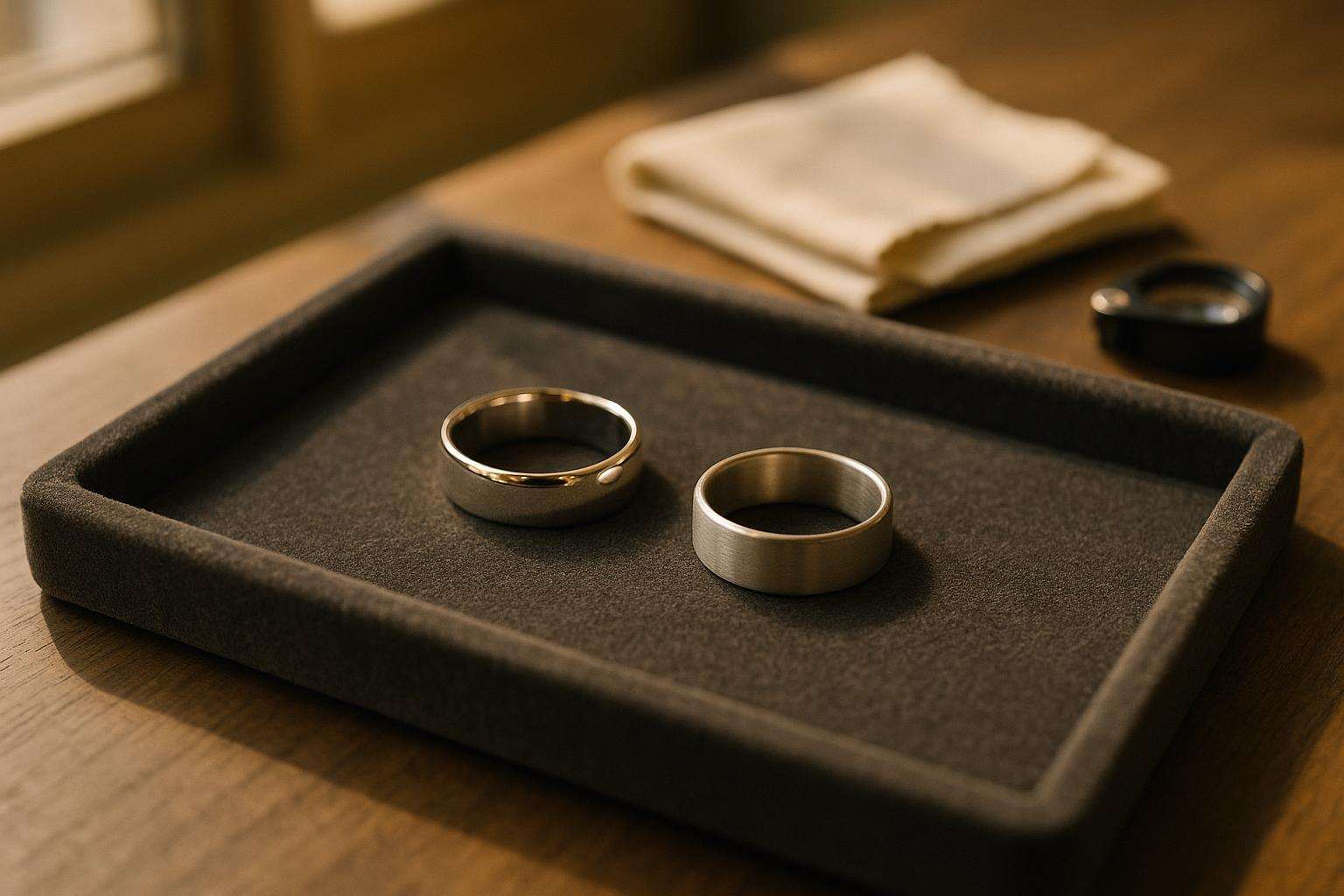
Platinum and white gold look nearly identical on your wedding day, but they age nothing alike. Platinum is solid, naturally white, hypoallergenic metal that softens into a patina and keeps its mass for life. White gold is a gold alloy plated in rhodium to read white — cheaper to buy, but it needs re-dipping every year or two to stay bright, and some alloys carry nickel. Choose platinum for low-maintenance permanence; choose white gold for a lower entry price you're willing to maintain.
If you're researching his ring while he's focused on everything else, the white-metal question is the one that quietly matters most. Two bands can look the same in the case and feel completely different a decade in. This is the premium-metal decision — platinum versus white gold — laid out plainly, with an eye on keeping his band and your ring in step for the long run. (For the harder, more modern metals like tungsten and titanium, that's a separate conversation; this is about the precious white metals.)
What is the actual difference between platinum and white gold?
It helps to know what each metal really is. White gold is yellow gold alloyed with white metals — commonly nickel or palladium — to lighten its color, then finished with a thin rhodium plating that gives it that bright, mirror-white look. A 14K white-gold band is about 58.5% gold; 18K is 75%, with the rest made up of the whitening alloy.
Platinum, by contrast, is used in fine jewelry as 950 platinum — about 95% pure, alloyed only with a little ruthenium or iridium for strength, and naturally white with no coating at all. So on the wedding day the two read almost the same bright white. The real difference is what lies beneath the surface: white gold's whiteness is a coating that wears, while platinum's whiteness is the metal itself, as both Blue Nile and Brilliant Earth explain.
Which is more durable for a man who works with his hands?
This is where a men's band earns its keep, because his ring tends to take harder daily contact than yours — desks, tools, steering wheels, the gym. Both metals are durable, but they behave very differently under wear.
Platinum is dense and slightly malleable, so when it's scratched the metal displaces — it's pushed to the side rather than shed. The ring keeps its mass over decades and gradually takes on a soft gray-satin patina. White gold's surface is a touch harder, but when it's scratched it actually loses a little material, so over many years a white-gold band thins faster than a platinum one. More noticeably, its rhodium plating wears unevenly — the back and top go first, revealing the warmer alloy beneath while the sides stay bright, which can look patchy until it's re-plated. Calla Gold Jewelry breaks this down well in its wedding-ring metal comparison.
For a hands-on groom, that durability story tends to favor platinum: it's the metal that asks the least of him over a lifetime of wear.
How much does the rhodium re-plating upkeep really cost?
This is the line item most couples never see coming. Because white gold's bright finish is a rhodium coating, it has to be restored periodically by having the ring dipped — re-plated. How often depends on how hard the ring is worn, but plan on roughly every one to three years, and sometimes as often as every twelve to eighteen months for a man who works with his hands. Each dip runs about $60 to $120 depending on the setting, per Blue Nile. It isn't expensive in isolation, but it's a recurring, lifelong cost — and a chore to remember.
Platinum sidesteps all of it. There's no plating to renew; the only maintenance is an occasional polish, and that's purely optional — many men simply let the patina be.
Is the price gap as big as people think in 2026?
Platinum has traditionally cost more than white gold, for two reasons: it's denser, so the same-size ring uses more metal by weight, and it was historically pricier per ounce. Both are still true at the cash register — at a men's-band specialist like Manly Bands, a build-your-own platinum band starts around $1,050, above comparable 14K white-gold builds.
But the raw-material gap has narrowed. Through 2026, gold's spot price has climbed well ahead of platinum's, so by melt value a heavier platinum band and a 14K white-gold band can land surprisingly close, as Versani's 2026 price comparison notes. Add years of re-plating to the white-gold side and the lifetime cost difference is smaller than the sticker suggests.
| Factor | Platinum (950) | White Gold (14K/18K) |
|---|---|---|
| Color source | Naturally white metal — no coating | Rhodium plating over a gold alloy |
| Durability | Displaces under wear; keeps its mass | Loses a little metal when scratched |
| Maintenance | Optional polish; develops a patina | Re-dip every ~1–3 yrs ($60–$120) |
| Allergy | Hypoallergenic (95% pure) | May contain nickel; ask for palladium-based |
| Upfront price | Higher | Lower |
| Lifetime cost | Front-loaded, then minimal | Lower start + ongoing re-plating |
What about allergies and coordinating with your ring?
Two last things worth checking before he commits. On allergy: some white-gold alloys are hardened with nickel, one of the most common contact allergens. The rhodium plating shields skin while it's intact, but exposure rises as the coating wears — a real consideration on a ring worn every day. If sensitivity runs in his family, ask specifically for a palladium-based white gold, or choose platinum, which is naturally hypoallergenic.
On coordination: if your engagement ring or band is platinum, matching his to platinum keeps the white tone identical for life, with nothing to re-plate and drift out of step. A platinum prong setting also tends to hold a center stone more securely over the years because it doesn't shed mass. If your ring is 14K white gold, his can match beautifully — just plan to have both re-dipped together so they age as a pair. The one outcome couples regret is not realizing white gold needs upkeep, then watching one ring quietly yellow before the other. Decide that now, together, and the rings will look as right in your fortieth-anniversary photos as they do on the day.
Frequently asked
Is platinum or white gold better for a man's wedding band?
It depends on what he values. Platinum is the better choice if he wants a naturally white, hypoallergenic metal that needs almost no upkeep and ages into a soft patina rather than thinning out — and he is comfortable with a higher upfront price. White gold is better if a lower entry cost matters and he doesn't mind having the ring re-plated every year or two to keep it bright. For a man who works with his hands, platinum's habit of displacing rather than losing metal makes it the more forgiving long-term option, per Calla Gold Jewelry.
Why does white gold need rhodium re-plating?
White gold is yellow gold mixed with white metals, so the raw alloy still carries a faint warm tone. To read bright, mirror-white, it is coated in rhodium. That coating wears with daily contact — first on the back and top of the band — exposing the warmer alloy beneath in a patchy way. Restoring the finish means having the ring dipped (re-plated), typically every one to three years and often sooner on a hard-worn men's band. Blue Nile puts a dip at roughly $60 to $120 depending on the setting. Platinum needs none of this.
Is platinum really more expensive than white gold in 2026?
At retail, yes — platinum bands still cost more up front because the metal is denser, so a ring of the same size uses more of it. But the raw-material gap has narrowed. Through 2026, gold's spot price has run well ahead of platinum's, so by melt value a heavier platinum band and a 14K white-gold band can land surprisingly close, notes Versani. Once you add years of white-gold re-plating, the lifetime cost difference shrinks even more.
Can white gold cause an allergic reaction?
It can. Some white-gold alloys use nickel as a hardening metal, and nickel is one of the most common contact allergens. While the rhodium plating is intact it shields the skin, but as the coating wears the underlying alloy can make contact and cause itching or redness on a daily-worn ring. If sensitivity is a concern, ask specifically for a palladium-based white gold, which is gentler, or choose platinum — which is naturally hypoallergenic because it is 95% pure with no plating, per Brilliant Earth.
Should his band match my ring metal?
It's worth coordinating, but it isn't a rule. If your ring is platinum, matching his to platinum keeps the white tone identical for life with no plating to drift. If your ring is 14K white gold, his can match — just plan to have both re-dipped together so they stay the same shade. The two read nearly identical when new, so mixing is also fine if he prefers one for durability or budget. What couples most often regret is not realizing white gold needs upkeep, then watching one ring yellow before the other.
What is the patina that platinum develops?
Patina is the soft, gray-satin sheen platinum takes on as countless tiny scratches accumulate and the surface gently diffuses light rather than mirroring it. Importantly, the metal isn't wearing away — platinum displaces under impact, so the ring keeps its mass; it simply looks softer and more matte over time. Many men prefer this lived-in look on a wedding band. If he'd rather keep it bright, a jeweler can polish platinum back to a high shine whenever he likes, as often as he wants, without removing meaningful metal.