Wedding Bands
Silicone Wedding Bands for Active Grooms: When a Backup Ring Makes Sense
A silicone band is not a downgrade from his real ring — it is the second ring that keeps the first one safe. Here is the case for it, grounded in real safety research and real prices.
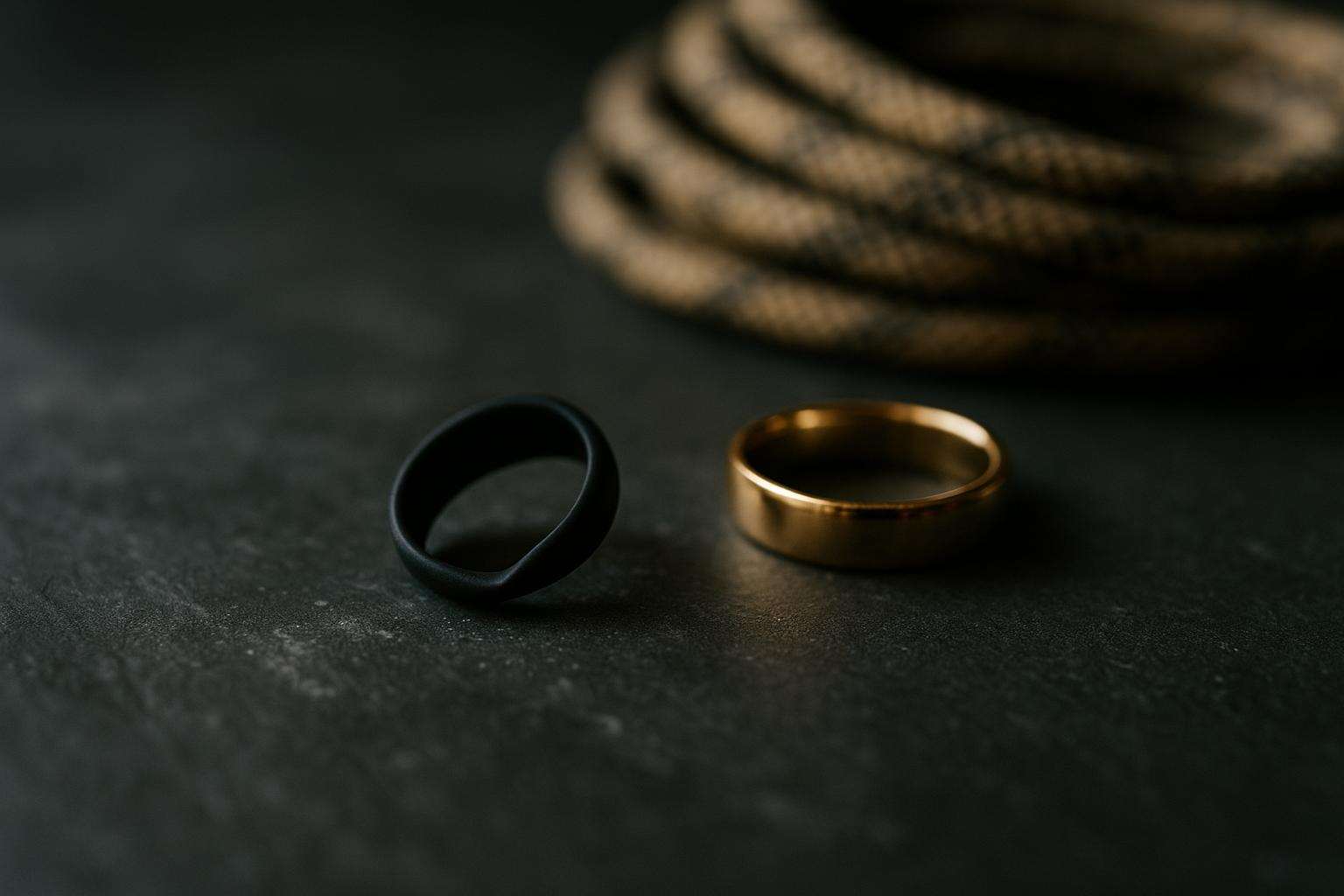
A silicone wedding band is not a downgrade from his real ring — it is the second ring that keeps the first one safe. For a groom who lifts, works with his hands, travels, or simply wants the band you chose together to look new in forty years, a medical-grade silicone ring (typically $12–$50) earns a permanent place beside the metal one. The case is not sentimental; it is practical, and it is backed by surgical research.
If he is the kind of man who is happiest with a barbell in his hands, a wrench, or a paddle, you may already have noticed the small hesitation when the subject of a wedding band comes up. It is not reluctance to be married. It is the quiet, sensible worry that a beautiful metal ring and an active life do not always sit well together — that it will get scratched, lost down a drain, or worse. The reassuring answer is that he does not have to choose. The modern solution is two bands: the metal one you select together for its meaning, and a flexible silicone wedding band for the hours when metal is a liability.
What is a silicone wedding band, and why would an active groom want one?
A silicone wedding band is a flexible ring made from medical-grade silicone — non-toxic, hypoallergenic, and engineered to bend and tear away under load rather than transfer force into the finger. It is sold expressly as an active or secondary band: something he can wear at the gym, on a job site, in the water, or on a long flight while the real band stays at home.
The category leader is Enso Rings, the medical-grade-silicone brand that drew national attention after appearing on Shark Tank in 2017. Enso speaks directly to “men who work in active, hands-on or hazardous environments — athletes, mechanics, electricians, construction workers, military personnel, healthcare workers.” Other makers such as SafeRingz occupy the same niche. As HuffPost reported, a growing number of grooms now choose silicone simply because it suits how they actually live.
The framing that matters here is simple: this is the backup, not the marriage. The metal band remains the symbol. The silicone band is the practical stand-in for the moments when wearing metal would be foolish.
Is ring avulsion a real risk, or just marketing?
It is real, and it is documented in the surgical literature rather than invented by ring brands. Ring avulsion happens when a ring catches on a fixed object — a ladder rung, a pickup bed, a basketball net — and the traction strips the soft tissue from the finger. At its most severe it means complete degloving or amputation. The Cleveland Clinic classifies these injuries by the Urbaniak system, from Class I (circulation intact) to Class III (complete degloving), and notes that finger avulsion and amputation injuries make up roughly 5% of all upper-extremity injuries seen in U.S. emergency rooms.
The decisive evidence is a 2021 biomechanical study in the Journal of Hand Surgery. Researchers pulled silicone and metal rings to failure on cadaver forearms. The numbers are stark, and worth keeping in mind:
| Ring material | Average failure force | Degloving injuries observed |
|---|---|---|
| Silicone (all sizes) | ~53.0 N | None |
| Silicone (clenched fist) | ~99.9 N | None |
| Metal (all sizes) | ~495.2 N | (stronger than the finger) |
The authors concluded that “the use of silicone rings should be encouraged in professions where ring avulsion injuries are more likely, such as heavy labor.” The logic is counterintuitive but sound: a metal band is far stronger than a finger, while a silicone band is weaker than a finger by design. That weakness is precisely the safety feature.
When does a silicone band actually make sense — and when not?
A backup band is not for every groom, and it does not belong in every moment. It earns its keep in clear situations:
- The gym and lifting. A knurled barbell or a pull-up bar is exactly the snag-and-pinch scenario metal handles badly.
- Trades and hands-on work. Electricians (silicone is non-conductive), mechanics, contractors, machinists.
- Water and travel. Swimming, paddling, the honeymoon beach — no loss down the drain, no resort-safe anxiety.
- First responders, military, healthcare. Professions repeatedly cited as higher-risk for hand injury.
- Sports with nets, rims, or cleats. Basketball, climbing, contact sports.
Where it does not belong is the ceremony itself, the reception, work events, or anywhere the symbol carries weight. The clean rule is two bands, one meaning. If swapping rings sounds like a chore, note that Enso also sells a hybrid system: a silicone insert nests inside a precious-metal shell, so he can pop the silicone out for a workout and reseat it for formal wear — one object, two modes.
What should he look for when choosing one?
The good news for the budget is that a quality silicone band is inexpensive. Enso prices most styles between about $11.99 and $49.99, with a lifetime warranty, and they are widely stocked at Walmart and Amazon as well as direct. Look for genuinely medical-grade, breathable silicone — grooved or vented interiors let sweat escape and prevent the trapped-moisture irritation that sinks cheaper rings. Match his true ring size, leaning to a snug rather than loose fit since silicone seats more closely than metal. Choose a finish that reads like a real ring — matte black, a brushed metallic tone, or a subtle stripe — rather than anything novelty, so it never looks like a toy on his hand. And buy at least two: at this price, a spare in the gym bag means he is never caught barehanded.
The honest summary for the partner doing this research: a silicone band is the unglamorous purchase that protects the glamorous one. It keeps the ring you chose together looking new, it keeps his finger safe in the places metal cannot go, and it costs less than a nice dinner. Few wedding decisions are this easy.
Frequently asked
Does wearing a silicone band mean he takes the marriage less seriously?
Not in the least, and it is worth saying plainly because it is the worry that lingers. A silicone band is a second ring, not a substitute for the one he stood at the altar with. The metal band remains the symbol; the silicone band is simply what he wears in the hours when metal would be a liability — the gym, the job site, the water. Many grooms describe it as protecting the real band: the ring you chose together stays pristine in its box for forty years precisely because the silicone one absorbs the daily wear. If anything, two rings signals that he intends to wear a band every day, not only when it is convenient.
Are silicone rings actually safer than metal ones?
Yes, and there is peer-reviewed evidence behind the claim rather than marketing alone. A 2021 biomechanical study in the Journal of Hand Surgery pulled silicone and metal rings to failure on cadaver forearms. Silicone rings broke at an average force of about 53 newtons; metal rings held to roughly 495 newtons — far stronger than the finger itself. There were no degloving injuries in the silicone group. The design logic is counterintuitive but sound: a band that is weaker than your finger will tear away before it strips the finger. That weakness is the safety feature.
What does a quality silicone wedding band cost?
Far less than the metal one, which is part of the appeal. Enso Rings, the category leader, prices most styles between roughly $11.99 and $49.99, and includes a lifetime warranty. Thin or “Ultralite” profiles sit at the lower end; textured, hammered, or hybrid designs reach the top. Because the band is consumable by nature — it is meant to give way under stress — an inexpensive ring that he can replace without a second thought is the point. Buy his real ring size, and consider a half-size note since silicone fits more snugly than metal.
Where should he wear the silicone band instead of his real ring?
Anywhere metal is a hazard or a worry. The clearest cases are lifting and the gym, hands-on trades such as electrical or mechanical work, water and the honeymoon beach, and sports with nets, rims, or cleats. Electricians value that silicone is non-conductive. Travelers value not losing a precious band down a hotel drain. The rule of thumb: if the activity could snag, soak, or strip the ring, the silicone one earns its place. Keep the metal band for the ceremony, the reception, and the moments where the symbol matters most.
Can he avoid switching back and forth between two rings?
To a degree, yes. Enso sells a clever hybrid system in which a silicone insert nests inside a precious-metal shell: he pops the silicone ring out for a workout and reseats it inside the metal band for formal wear, so there is only one object to keep track of. Short of that, most grooms simply keep the silicone band in a gym bag or by the back door and the metal band in its box at home. Either approach works; the hybrid just removes the friction of remembering to swap.
Is silicone safe to wear against the skin all day?
Reputable brands use medical-grade, non-toxic, hypoallergenic silicone, which is well tolerated by most skin even over long wear. The more common comfort issue is moisture trapped underneath the band, which is why many lines now use breathable or grooved interiors that let air and sweat escape. If his skin is sensitive or his hands are often wet, choose a breathable profile and take the ring off to dry the finger periodically. As the Cleveland Clinic notes on ring safety generally, the safest habit of all is removing any ring around heavy machinery.