Fit & Tailoring
Jacket Length and Trouser Break: Proportion Rules for the Groom
Two small tailoring adjustments — how far his jacket falls and how his trousers meet the shoe — quietly decide whether the suit looks balanced in every photograph.
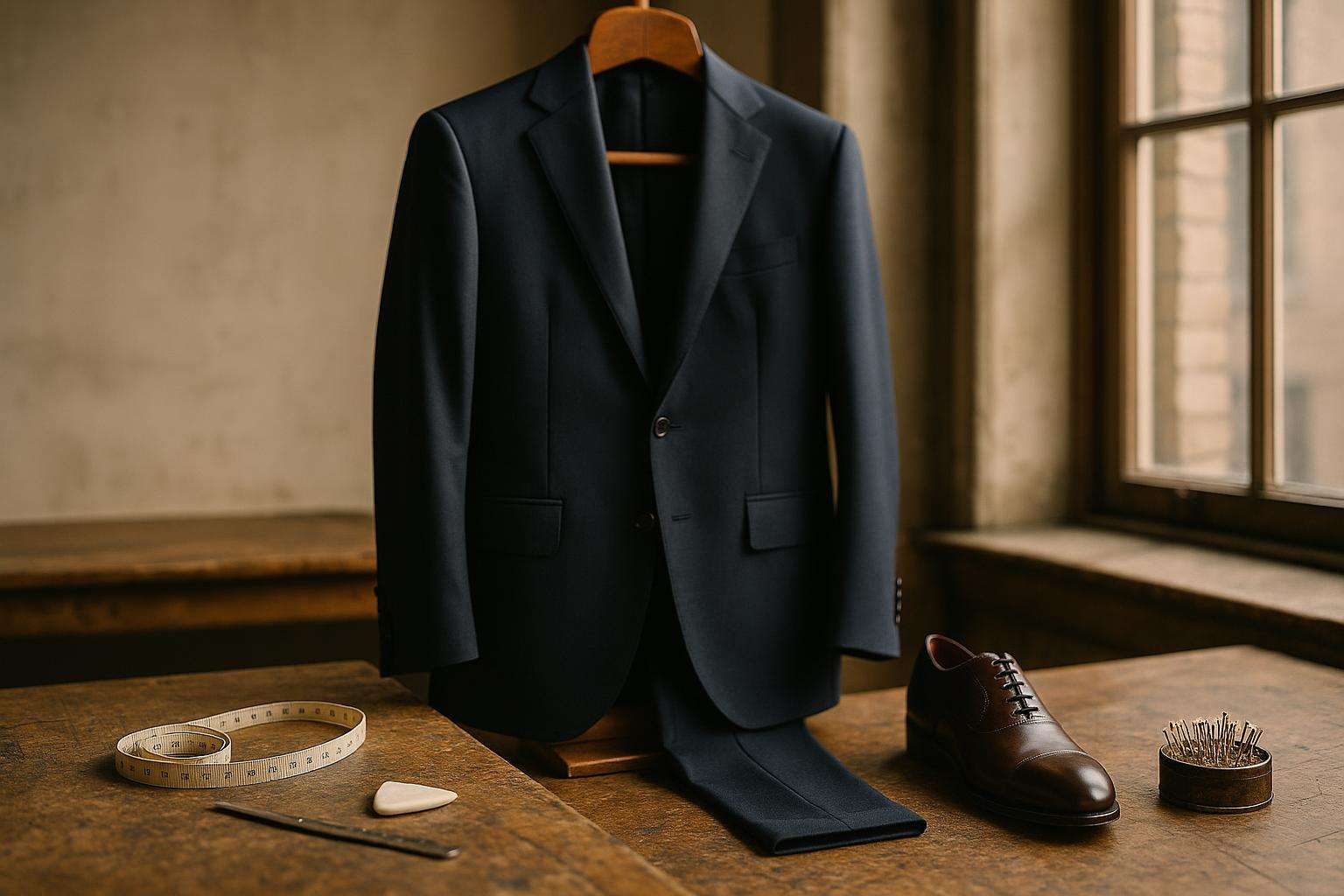
Two cheap, high-leverage adjustments decide whether his wedding suit looks proportioned in every photograph: jacket length (the hem should fully cover his seat) and trouser break (how the hem meets the shoe). When in doubt, cover the seat and choose a half break — both are universally flattering, and both are far easier to set at the first fitting than to rescue in the final week.
When you are coordinating his look, the conversation tends to circle color, lapels, and whether it is a suit or a tuxedo. Those matter. But two quieter adjustments do more for how he actually photographs: how far the jacket hem falls, and how the trouser meets the shoe. Get them right and an off-the-rack suit reads bespoke; get them wrong and even a fine cloth looks borrowed. Both are matters of proportion, and proportion is what the camera reads first.
How long should a groom's suit jacket be?
The rule that does most of the work is seat coverage: the hem should fall far enough to cover his seat in back and the trouser line in front. Covering the seat visually connects his legs to his torso, lengthening the silhouette and reading as taller and more balanced — a hem cut too short exposes the trouser top and chops the figure in half.
The in-the-mirror test is simple. Have him stand naturally, arms relaxed, fingers gently curled: the hem should reach about where his cupped hand can hold the bottom of the jacket, roughly at the second joint of the thumb. As a proportion check, the jacket length should land near half the distance from the base of his collar to the floor. The tolerance is forgiving — within about three-quarters of an inch of ideal is fine; this is guidance, not a laboratory measurement.
Style shifts the dial slightly. A longer hem reads more traditional and formal; a marginally shorter one reads modern. A groom with a long torso can go a touch shorter to balance his legs, while a shorter groom should still insist on full seat coverage. The detail guides at Men's Wearhouse and the bespoke notes at Articles of Style both treat seat coverage as the anchor and personal style as the fine adjustment.
Why is jacket length so hard to fix — and when should you check it?
Here is the part most couples discover too late: jacket length is one of the hardest things on a suit to alter. A tailor can typically shorten a jacket by up to about an inch, but lengthening is nearly impossible — there is no hidden fabric folded into a jacket hem the way there is in a trouser, and shortening also disturbs the front pockets and the balance of the buttons. Proper Cloth puts it plainly: if the length is off by more than an inch, the honest answer is a different size or a made-to-measure jacket.
The practical lesson is about timing. Confirm jacket length at the first fitting, while there is still time to exchange the size or recut the order. The trouser hem can be set late and cheaply; the jacket cannot. If you are renting or buying off-the-rack, this is the single measurement to obsess over before you commit to a size.
What is a trouser break, and which one should the groom choose?
The break is the fold of fabric that forms where the trouser hem rests on the shoe — it literally "breaks" the clean vertical line of the trouser. The amount of break sets how modern or traditional the whole suit reads, and it photographs plainly. There are four standard choices, running from cleanest to most relaxed:
| Break | Fabric at the shoe | Reads as | Best for |
|---|---|---|---|
| No break | Hem just kisses the shoe; a little ankle/sock shows | Cleanest, most modern | Slim trousers; shorter grooms wanting height (watch for floods) |
| Quarter break | Light single fold, ~0.5" front sloping to ~0.75" back | Contemporary yet conservative | Most grooms; slim-to-medium leg — the wearable default |
| Half break | One soft horizontal fold dipping across the front | Traditional standard | Everyone; all heights and settings — the safe choice |
| Full break | Significant pooling, covers to mid-shoe at the back | Old-school, formal, vintage | Taller or larger grooms; wider trouser legs |
The proportion logic is straightforward. Per Gentleman's Gazette, shorter or slimmer grooms look taller in a no or quarter break, taller or larger grooms carry a half or full break well, and the half break flatters everyone — which makes it the natural wedding default when he is unsure. Break should also harmonize with leg width: slim legs want a no or quarter break, wider legs a half or full break. Forcing a full break onto a slim trouser produces an ungainly ripple at the shoe rather than an elegant pool.
Should his trousers be cuffed or uncuffed, and how do these choices show up in photos?
Cuffs change the math. The added weight at the hem pulls the trouser down into a cleaner line, so cuffed trousers can be hemmed slightly shorter with less break. Uncuffed trousers generally want a half to full break — an uncuffed no-break hem has nothing to hold it down, so it rides up and clings to the sock, reading as too short. For most formal wedding suits, a clean uncuffed trouser with a quarter-to-half break is the timeless answer; cuffs lean traditional and vintage.
Remember what the camera will actually capture. He will be photographed standing at the altar, seated at the head table, kneeling for the first look, and walking the aisle. A jacket that covers the seat holds an unbroken silhouette from every angle; a conservative quarter-to-half break keeps the trouser line crisp whether he is upright or mid-stride. Excess fabric — a too-long jacket or a heavy full break — photographs as bunching and shortens him. When in doubt, err slightly clean: covered seat, modest break. It is the most photogenic, most forgiving way to dress him, and it costs almost nothing to get right at the fitting.
Frequently asked
How long should the groom's suit jacket be?
The hem should fall far enough to fully cover his seat and the front trouser line — that single rule does most of the work, because covering the seat visually links the legs to the torso and makes him read taller and more balanced. In the mirror, have him stand with his arms relaxed and fingers gently curled; the hem should reach about where his cupped hand can hold the bottom of the jacket. A useful proportion check is that the jacket is roughly half the distance from the base of the collar to the floor. A longer hem reads more traditional and formal; a slightly shorter one reads modern. As Oliver Wicks notes, seat coverage is the most reliable test.
Can a tailor shorten a wedding jacket if it is too long?
Only a little — and this is why length matters at the first fitting, not the last. A tailor can usually shorten a jacket by up to about an inch, but lengthening is close to impossible because there is no spare fabric folded into the hem the way there is in a trouser. According to Proper Cloth, if the length is off by more than an inch you are likely looking at a different size or a made-to-measure jacket. Confirm length early, while there is still time to exchange or recut, rather than discovering it in the final week.
What is a trouser break, and which one is safest for the wedding?
The break is the fold of fabric that forms where the trouser hem meets the shoe. There are four: no break (the hem just kisses the shoe), quarter break (a light single fold), half break (one soft horizontal fold across the front), and full break (significant pooling). The half break is the safe wedding default — Gentleman's Gazette calls it flattering across all heights and body types and appropriate in every setting. If he prefers a cleaner, more modern line, a quarter break is the next most wearable choice.
Does his height change which trouser break he should choose?
It does. Shorter or slimmer grooms look taller in a no break or quarter break, because a heavy fold can visually cut the leg off at the ankle. Taller or larger grooms carry a half or full break comfortably, and the extra fabric balances their proportions. Average builds are safe with anything from no break to a half break. The break should also match the trouser leg: slim legs want a no or quarter break, while wider, more relaxed legs want a half or full break — pairing a full break with a slim leg tends to produce an awkward ripple at the shoe.
Should the groom's trousers be cuffed or have no break?
That depends partly on each other. Cuffs add weight at the hem, which pulls the trouser down into a cleaner line, so cuffed trousers can be hemmed a touch shorter with less break. Uncuffed trousers generally want a half to full break: an uncuffed no-break hem has no weight to hold it down, so it tends to ride up and catch on the sock, reading as too short. For most formal wedding suits a clean uncuffed trouser with a quarter-to-half break is the timeless choice; cuffs suit a more traditional, vintage-leaning look.
How do jacket length and trouser break affect the wedding photos?
More than almost any other small detail. Wedding photographs catch him standing at the altar, seated at the head table, kneeling for the first look, and walking — and both length and break either hold a clean line through all of those poses or fall apart in them. A jacket that covers the seat keeps his silhouette unbroken from the front and the back; a conservative quarter-to-half break keeps the trouser line crisp whether he is upright or mid-stride. Excess fabric — a too-long jacket or a heavy full break — photographs as bunching and can make him look shorter. Erring slightly clean is the photogenic choice.